

Twenty years ago, a piece of US legislation brought the online poker boom to an abrupt end, emptying PartyPoker’s tables, turning PokerStars into an industry giant and setting the stage for Black Friday. For the professionals who lived through it, the consequences went far beyond the poker tables.
I had turned professional as an online poker player only a few months earlier, and I’ve never forgotten what happened to PartyPoker in October 2006.
The $530, $215 and $109 sit-and-go tournaments were my hunting ground, the place where I made my living against a mix of fellow professionals and the recreational players fuelling the online poker boom. Then, almost overnight, the games stopped running. Tournaments that used to fill without fuss struggled to attract enough players to start. It was extraordinary to watch.
PartyPoker, then the dominant force in online poker, had withdrawn from the United States following the passage of the Unlawful Internet Gambling Enforcement Act (UIGEA). Its parent company, PartyGaming, saw its share price collapse and was dropped from the FTSE 100, while PokerStars decided to keep accepting American players.
That decision would help propel PokerStars to the top of the global industry and, five years later, leave it exposed to the US Department of Justice crackdown that became known as Black Friday.
For American online poker, October 2006 marked the start of a transformation from which it has never fully recovered. For those of us playing professionally at the time, the consequences were immediate.
The Poker Boom Before UIGEA
To understand the scale of the disruption, it’s worth remembering just how extraordinary the poker industry had become. In 2003, Tennessee accountant Chris Moneymaker won the World Series of Poker Main Event and $2.5 million after qualifying through an online satellite tournament on PokerStars.
His victory convinced millions of ordinary people that poker could be more than a recreational pastime. You didn’t need to be a Las Vegas professional to compete for the game’s biggest prizes, because you could qualify from your living room.
Online poker rooms seized the opportunity. PartyPoker, PokerStars, Full Tilt Poker and others competed for players with enormous tournament guarantees, lucrative promotions and increasingly sophisticated software. Televised poker was everywhere, professionals were becoming celebrities, and online play offered the prospect of making a living without ever setting foot inside a casino.
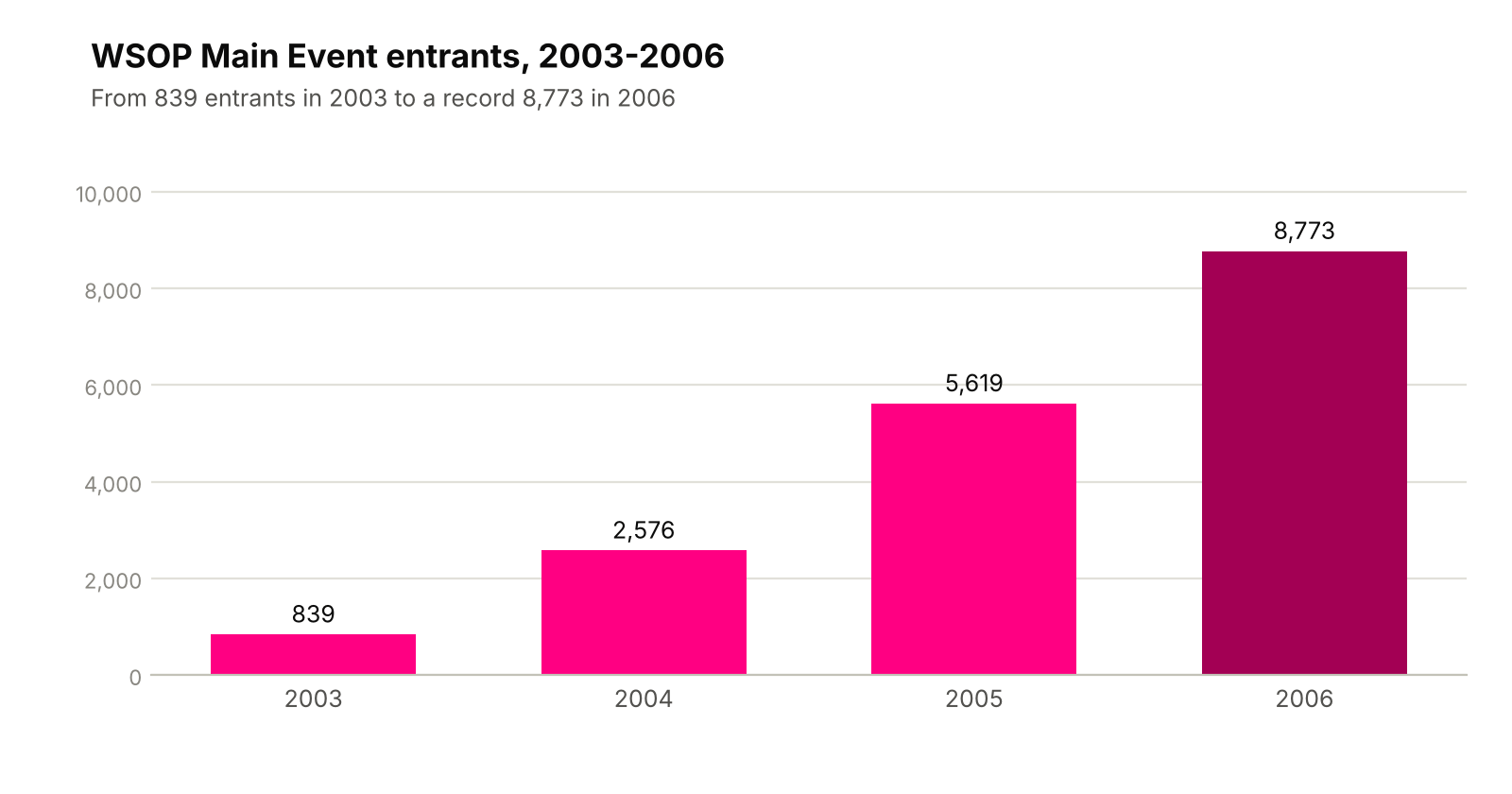
The World Series of Poker provided the most visible evidence of the boom. The Main Event drew 839 entrants in 2003, more than tripled to 2,576 the following year and reached 5,619 by 2005. Then came 2006, when a staggering 8,773 players entered the $10,000 Main Event, generating an $82.5 million prize pool. Jamie Gold took home $12 million, the largest Main Event first prize ever awarded at the time.
The link between online and live poker was fundamental to that growth. Online rooms ran satellites that let players win seats in major live tournaments for a fraction of the normal buy-in, so the Moneymaker dream was repeated thousands of times, with the internet providing the pathway to Las Vegas. For casinos, online poker had become one of the most effective recruitment tools imaginable. And then Washington intervened.
How a Port Security Bill Changed Poker
On October 13, 2006, President George W. Bush signed the SAFE Port Act into law. Buried within the legislation, which primarily concerned maritime security, was the Unlawful Internet Gambling Enforcement Act. UIGEA had been attached to the bill in the final stages of the congressional process, after years of effort by opponents of internet gambling to introduce federal restrictions.
One of the most prominent advocates was Arizona Republican Sen. Jon Kyl, who died in September at the age of 84. Kyl spent years campaigning against online gambling and was closely associated with the legislative push that culminated in UIGEA.
The law itself was unusual. Rather than directly criminalizing the act of playing online poker, it prohibited gambling businesses from knowingly accepting payments connected to internet gambling that was already unlawful under federal or state law. In other words, it targeted the financial infrastructure rather than banning every form of online gambling outright.
That distinction created a complicated legal landscape. Some operators concluded that the risk of continuing to serve American customers was unacceptable, while others argued that poker’s legal status remained uncertain enough for them to carry on. The gap between those interpretations would determine the future of the industry.
PartyPoker Walks Away
PartyPoker was the biggest casualty. Its parent company, PartyGaming, had floated on the London Stock Exchange in 2005 and became one of the most prominent publicly traded names in online gambling, with the American market central to its success. But the listing also brought obligations and commercial pressures that made continuing to accept US customers especially difficult, and PartyGaming chose to withdraw.
The financial markets had already reacted brutally when Congress passed UIGEA in late September. PartyGaming’s share price collapsed and it lost its FTSE 100 place before President Bush had even signed the legislation. The withdrawal of American real-money customers followed on October 13, with devastating consequences. Contemporary reporting suggested PartyPoker’s revenue could have fallen by as much as 90%, and PartyGaming even removed the player and table-count ticker from its website as liquidity collapsed.
Those figures matched exactly what I was seeing on my own computer. The games had disappeared, and with little time to dwell on the politics, professional players like me had to find somewhere else to make a living.
My Less Than Triumphant Arrival at PokerStars
My destination was PokerStars, although the move didn’t exactly get off to a flying start. I downloaded the software, installed it and logged in, only to discover that I couldn’t work out how to deposit any money or find any of the sit-and-go tournaments I wanted to play. It took me two days to realize I’d downloaded PokerStars.net, the free-play version, instead of PokerStars.com, where the real-money games were running. It was not an auspicious start to my new professional career.
Once I found the right software, the real problems began. I wasn’t the only PartyPoker refugee looking for a new home, and professionals who had previously been spread across different sites were suddenly converging on PokerStars, a much smaller operation than PartyPoker at the time. Its recreational player base simply wasn’t large enough to absorb the influx of experienced players, and the balance between recreational players and professionals shifted dramatically.
At PartyPoker, the higher-stakes sit-and-gos had been a consistently profitable environment. At PokerStars, I was suddenly up against a far higher concentration of players who, like me, depended on poker to pay their bills. The competition was ferocious, and I had to drop down in stakes to become consistently profitable again. It took several months for PokerStars to build up enough recreational players for the games to regain something resembling their previous balance.
That experience taught me something about the economics of online poker that has stayed with me ever since: player liquidity isn’t simply about having more people at the tables. The composition of the player pool matters enormously, and a room full of professionals competing against one another is a very different proposition from one with a healthy mix of experienced and recreational customers. For PokerStars, the exodus from PartyPoker was an enormous commercial opportunity. For the professionals making the journey, it was considerably less straightforward.
PokerStars Takes the Gamble
While PartyGaming decided UIGEA made the American market untenable, PokerStars and Full Tilt Poker took a different approach and kept accepting US customers. For PokerStars, staying meant access to an enormous market that several major competitors had abandoned, and over the following years the company expanded rapidly to become the world’s dominant online poker brand.
The decision carried risk, though. UIGEA didn’t explicitly prohibit Americans from playing online poker, but it did make processing certain gambling-related payments unlawful. The implementing regulations, finalized in 2008 and subject to mandatory compliance from June 2010, increased the pressure on banks and payment processors, and operators serving American customers faced mounting difficulties moving money in and out of player accounts. According to later federal allegations, some operators and their payment processors responded by disguising gambling transactions as payments for unrelated goods and services.
For players, much of this stayed invisible. The games were running, deposits and withdrawals were still being processed, and major online tournaments continued to draw substantial fields. It was easy to believe the crisis of 2006 had passed. It hadn’t.
Black Friday: April 15, 2011
Five years after UIGEA, American online poker suffered a second and far more devastating shock. On April 15, 2011, the US Department of Justice unsealed indictments against individuals associated with PokerStars, Full Tilt Poker and Absolute Poker, with charges including bank fraud, money laundering and illegal gambling offenses. Federal authorities also seized or restricted access to the companies’ internet domains, replacing familiar poker websites with government notices. The day became known throughout the poker world as Black Friday.
For American players, the effect was immediate. PokerStars stopped offering real-money games to US customers and Full Tilt followed, and this time there was no obvious alternative waiting to welcome the displaced players, because the major sites that had kept serving Americans after UIGEA were now the targets of the same federal action. Uncertainty over player balances made matters worse, as Full Tilt’s subsequent financial problems revealed that the company didn’t have enough readily available funds to meet its obligations to customers. PokerStars eventually reached a $731 million settlement with the Department of Justice in 2012, acquiring Full Tilt’s assets and enabling the repayment of eligible players. But for American online professionals, the damage had already been done and their livelihoods had disappeared.
When Playing Poker Meant Leaving America
For recreational players, Black Friday meant losing access to a favorite pastime. For professionals, it meant something much more serious. Many had spent years honing their skills, building bankrolls and establishing careers that let them work from home, and for many US-based players that was suddenly no longer a realistic option.
I watched friends confront an extraordinary choice: abandon their careers or leave their country. Some emigrated to Canada, while others moved to Mexico, where they could keep playing on international poker sites. These weren’t people relocating for an adventure or a change of scenery. They were moving because the profession they’d chosen was no longer viable from their homes in the United States.
One friend tried to find a compromise. Rather than uproot his family, he commuted to Canada every week so he could keep playing online, an arrangement that proved unsustainable because he missed his family too much. Eventually he gave up professional poker altogether and took a job as a correctional officer in a prison.
I often think about that story when people discuss UIGEA and Black Friday purely in terms of operator revenues, market share or the number of states that have since legalized online poker. Behind those statistics were real people whose lives were turned upside down. In 2006, UIGEA forced me to find a new poker room. Five years later, Black Friday forced some of my friends to find a new country.
The Damage to Live Poker
The consequences weren’t confined to the internet. The relationship between online poker and land-based casinos had been one of the defining features of the boom: online satellites gave ordinary players a way into major live tournaments without paying the full entry fee, introduced new players to the game, created television stars and helped drive unprecedented participation in the World Series of Poker.
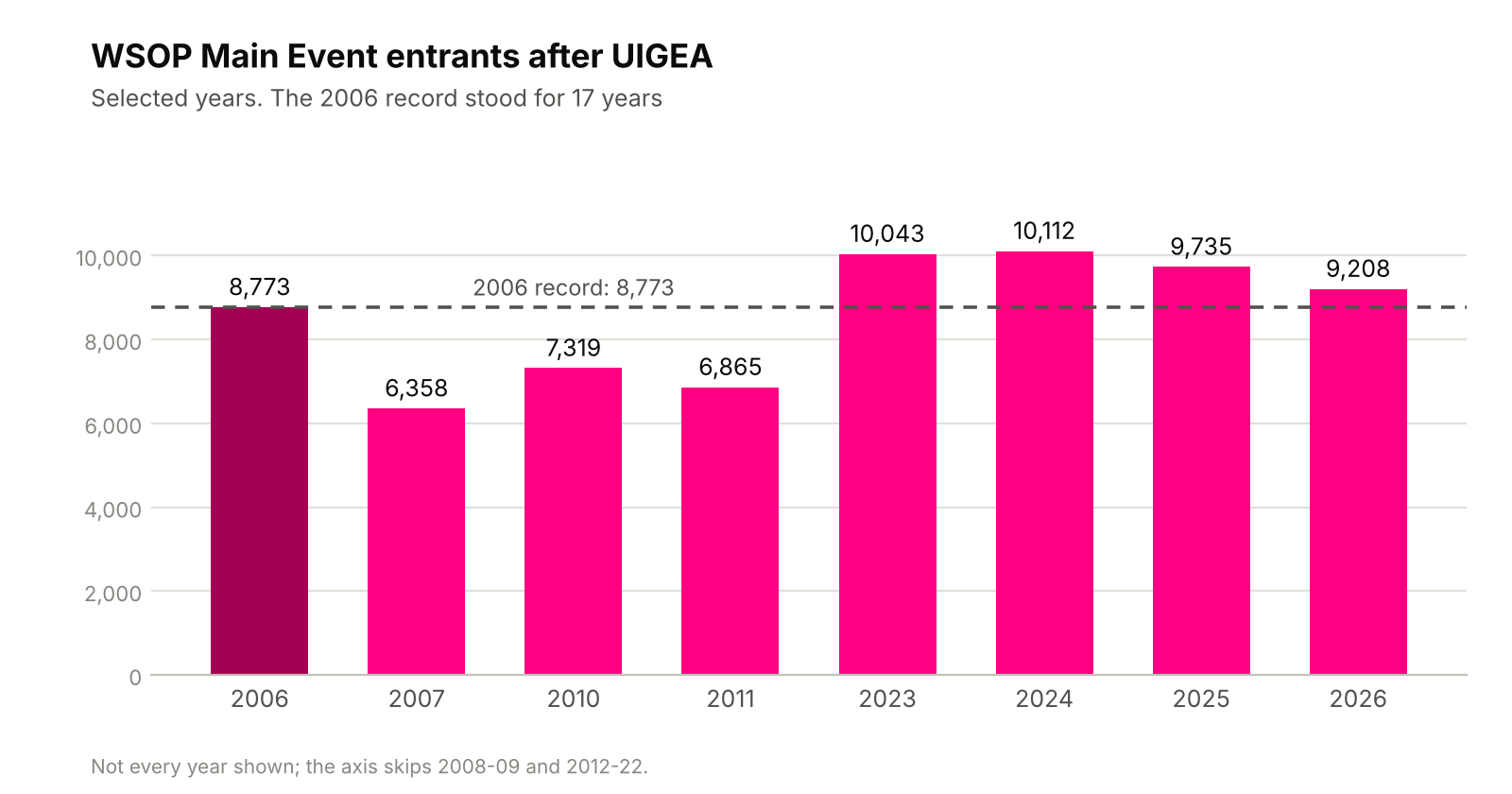
The WSOP Main Event attendance figures show how dramatically that growth changed after UIGEA. The record 8,773 entrants in 2006 fell to 6,358 in 2007, a drop of 27.5% in a single year. The tournament remained hugely successful by historical standards, but the explosive growth of the Moneymaker era had stopped, and the 2006 record proved remarkably hard to beat. The 2010 field of 7,319 was still well below that peak, and in 2011, just months after Black Friday, 6,865 players entered. Attendance fluctuated over the following decade, but the 2006 record stood.
It would be simplistic to attribute every change in Main Event attendance to UIGEA. The global financial crisis, shifting economic conditions and the natural cooling of an extraordinary boom all played a part. Even so, the withdrawal of major online operators from the American market disrupted one of the most effective mechanisms for bringing new players into live casino poker. Online satellites had made the dream of playing in the Main Event accessible to an enormous audience, and without the same unrestricted access to international poker rooms, that pathway became considerably narrower for American players.
The effects reached beyond the Main Event. The online boom had introduced an entire generation to live casino poker, with players who learned the game online progressing to cash games, tournament circuits and major events at land-based properties. The relationship was mutually beneficial, and its disruption changed the trajectory of both industries.
Seventeen Years to Break the Record
Live poker did recover, but it took a remarkably long time. Not until 2023 did the Main Event finally surpass its 2006 attendance record, drawing 10,043 entrants. It set another record with 10,112 entries in 2024 before slipping to 9,735 in 2025 and 9,208 in 2026.
Those figures demonstrate the resilience of live tournament poker. The Main Event has survived UIGEA, Black Friday and the transformation of the online gambling industry, and at its peak it has attracted more players than ever before. But it took 17 years to beat the record set during the original boom, which raises an intriguing question: how much bigger might live poker have become if the growth of the online industry had continued uninterrupted? There’s no reliable way to answer it.
What we do know is that the spectacular expansion between 2003 and 2006 gave way to a prolonged period of relatively stagnant attendance, and that the eventual resurgence was driven by an industry that had adapted to a different environment. International participation, expanding tournament circuits, new marketing channels and the continuing appeal of poker’s biggest prize all helped rebuild momentum.
Live poker found a way forward. American online poker, however, has followed a very different path.
The Fragmented Return of Legal Online Poker
In the years after Black Friday, regulated online poker gradually returned to parts of the United States. Nevada launched its first regulated real-money games in 2013, followed by Delaware and New Jersey, and other states have since authorized online poker, creating the foundations of a domestic regulated market. But the new system is fundamentally different from the one that existed before UIGEA.
In 2006, Americans could play alongside players from around the world, although the legality of the operators’ activities was disputed. The modern regulated market has developed state by state.
That’s a particular problem for poker. Unlike online slots or sports betting, poker pits players against one another, so a successful room needs enough participants to sustain games across different stakes, formats and times of day. The larger the player pool, the easier it is to offer attractive tournaments, substantial guarantees and a wide choice of cash games, and restricting operators to individual state populations makes that considerably harder.
Interstate liquidity-sharing agreements (MSIGA) have helped by allowing players in participating states to compete against one another, but the American market remains fragmented. Twenty years after UIGEA, access to regulated online poker still depends heavily on where a player happens to be physically located, a remarkable limitation for a game that once brought together players from around the world. The only US states where you can play regulated online poker are Michigan, Pennsylvania, West Virginia, New Jersey, Nevada, Connecticut and Delaware.
Why Sports Betting Has Overtaken Poker
There’s another irony in the way American online gambling has developed over the past two decades. Poker was one of the principal drivers of the original internet gambling boom, yet when the United States began opening up regulated online markets, it was sports betting that captured most of the attention.
After the Supreme Court’s 2018 decision overturning the federal restriction on state-authorized sports betting, legal sportsbooks expanded rapidly across the country, and major operators invested heavily in advertising, sponsorships, technology and customer acquisition. Online poker hasn’t enjoyed a comparable nationwide revival.
Part of the explanation lies in the economics. Sportsbooks don’t need customers to compete against one another, so they can offer betting markets within individual states without relying on shared player liquidity. A small, isolated poker pool can struggle to support a healthy range of games, particularly at higher stakes or outside peak hours. Commercial incentives differ too: online casino games and sports betting can generate substantial operator revenues, while poker rooms generally earn their money through rake and tournament fees.
For operators and state governments deciding where to concentrate their resources, poker has often become a secondary priority, and the game that helped establish online gambling as mainstream entertainment has struggled to regain its former position in the United States.
The Law That Changed My Career
For me, the consequences of UIGEA and Black Friday weren’t confined to the poker tables. When I turned professional in 2006, I had no reason to imagine that legislation passed thousands of miles away in Washington would so profoundly affect my chosen career.
The immediate aftermath of UIGEA was difficult enough: I watched my favorite games disappear from PartyPoker, spent two days wondering why I couldn’t deposit money on PokerStars and eventually adapted to a much tougher playing environment.
Black Friday was different. The disappearance of American players from the international online poker market made the games considerably harder to beat, the balance between recreational players and professionals shifted once again, and making a consistent living became increasingly challenging.
I began supplementing my poker income by writing about the game, and gradually the journalism became more important than the poker. By 2013, two years after Black Friday, I had made the transition to writing full time.
Today, I head the North America team at Casinos.com, an unexpected destination for someone who, twenty years ago, was making a living playing $530, $215 and $109 sit-and-go tournaments on PartyPoker. There’s a certain irony in the fact that the legislation that helped end my career as a professional player also set me on the path to the job that allows me to write this retrospective.
I was fortunate to find another way to make a living in an industry I loved. Others weren’t so lucky, and some of my American friends moved abroad to keep playing while others abandoned poker altogether.
Twenty years after UIGEA, the World Series of Poker has finally surpassed the attendance records set during the original poker boom, and regulated online poker has returned to parts of the United States in ways few of us could have imagined in 2006.
But American online poker has never returned to the borderless market that existed before UIGEA, and the Main Event figures, for all they say about eventual recovery, can’t capture the careers that ended, the families that relocated or the opportunities that disappeared along the way.
I still remember those deserted PartyPoker lobbies in October 2006. At the time, I thought I was witnessing the end of an era for a poker room. I didn’t realize I was watching the beginning of the end of an era for American poker itself, or that twenty years later I’d be writing about it for a living.
Meet The Author
Experience

Joss Wood has over a decade of experience reviewing and comparing the top online casinos in the world to ensure players find their favorite place to play. Joss is also a specialist when it comes to breaking down what casino bonuses add value and where to find the promotions you don't want to miss.
Read Full BioRelated News










Test Your Luck
Not Your Spam Filter
Sign up to receive emails and promotions from Casinos.com