NFL Takes Prediction Market Fight to Supreme Court: Where All the Leagues Stand


The NFL has taken the lead among sports leagues, supporting New Jersey’s effort to convince the U.S. Supreme Court that prediction markets like Kalshi are engaging in state-regulated sports betting, not federally regulated commodities exchanges. (Illustration: Casinos.com / ChatGPT)
The National Football League has made its position on sports-event contracts clear. Now it wants the U.S. Supreme Court to confirm it.
On Thursday, Oct. 8, the league filed an amicus brief supporting New Jersey’s request that the justices review its dispute with Kalshi over who gets to regulate the contracts. The NFL did not bring the underlying lawsuit; it weighed in on an existing case and argued that states are better positioned than the Commodity Futures Trading Commission to oversee sports-related trading.
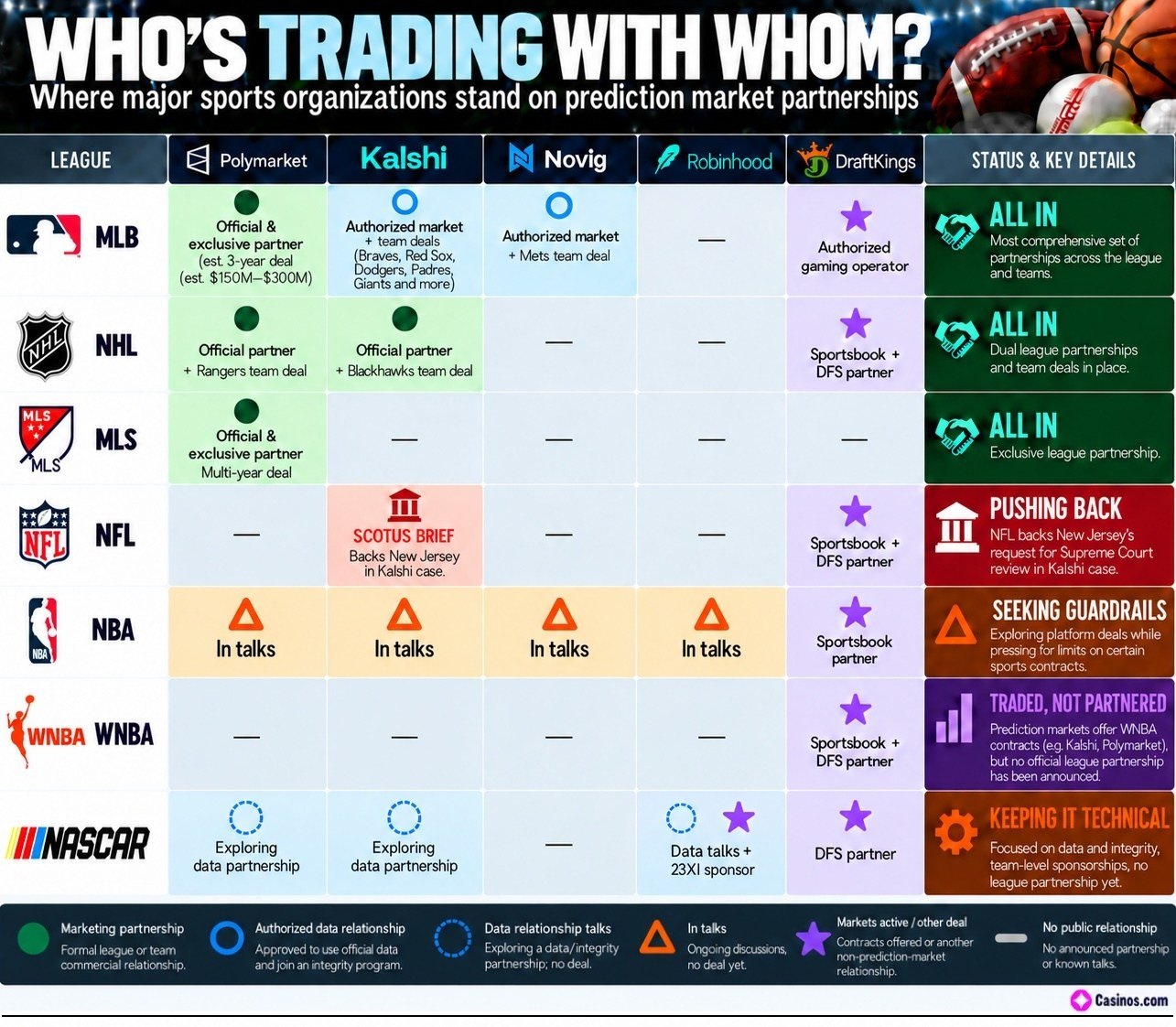
The move puts the NFL on a decidedly different path from several other major sports organizations. MLB, the NHL and MLS have signed commercial deals with trading platforms, while the NBA has explored agreements of its own. The WNBA hasn’t struck an official partnership, either. NASCAR has kept its distance from the industry commercially, showing interest in data-sharing deals meant to protect race integrity but holding off on any sponsorship-style tie-up.
Those positions haven’t been static. Leagues that once shunned trading platforms have warmed to partnerships over the past year. With the NFL’s Supreme Court brief raising the stakes, most organizations now appear to be settling into the stances they’ll carry forward — whether that means embracing prediction markets as partners, limiting them to data-sharing arrangements, or, like the NFL, challenging their legal footing outright.
So where does each league currently stand?
Event contracts tied to sports make up the lion’s share of volume at platforms like Kalshi and Polymarket, with some estimates suggesting as much as 90% of activity at Kalshi — and a majority across the industry — is traded on sporting events.
But there’s a wide range of approaches when it comes to how major sports organizations are engaging with the industry. From embracing it to keeping it at arm’s length, here’s a look at what the big leagues are doing — and how that might change moving forward.
MLB, NHL Already on Board
Of the biggest sports organizations in North America, none has done more to tie itself to prediction markets than Major League Baseball.
In March 2026, MLB announced a deal that made Polymarket its exclusive prediction market exchange partner. While financial details of the arrangement were not officially announced, sources have estimated that Polymarket is paying anywhere from $150 million to $300 million for a three-year deal with baseball’s top league. In addition, MLB has named Kalshi and Novig as “authorized prediction markets,” allowing them to use official league data in exchange for participating in the league’s integrity program.
The baseball integration goes beyond the league. Five teams — the Atlanta Braves, Boston Red Sox, Los Angeles Dodgers, San Diego Padres and San Francisco Giants — have partnered with Kalshi. The two New York teams also have official partners, with the Yankees partnering with Polymarket while the Mets are the first team partner for Novig.
A similar process has taken place in the NHL. In October 2025, the NHL announced nonexclusive deals that made both Kalshi and Polymarket official league partners. Kalshi reached another partnership with the Chicago Blackhawks in December 2025, with Polymarket making a deal with the New York Rangers in January 2026.
Also on board is Major League Soccer. In January 2026, MLS made Polymarket its exclusive partner in the category, though there were no financial details released for the multiyear deal.
NFL Pushes Back as NBA Explores Deals
By contrast, the NFL has been by far the most adversarial toward prediction-market platforms. The league has asked operators not to offer contracts that could be easily manipulated, such as discrete prop bets, though those markets continue to appear on major sites. Commissioner Roger Goodell has said the NFL won’t partner with any platform until he believes stronger regulations are in place.
That stance became more consequential Oct. 8. In its Supreme Court brief, the NFL backed New Jersey’s position that the Commodity Exchange Act does not prevent states from applying their gambling laws to sports-event contracts. The league also questioned whether the CFTC has enough resources and sports-specific safeguards to address insider trading, manipulation and other integrity risks.
The NBA has been talking to major platforms — including Polymarket, Kalshi, Fanatics, Novig and Rothera — in an effort to finalize one or more official partnerships, likely ahead of the 2026-27 season, though none had been announced by early October 2026. It’s unclear if any deals could also include an official relationship with the increasingly popular WNBA.
That hasn’t prevented a few smaller deals from taking place. LeBron James has his own endorsement agreement with Polymarket said to be worth $15 million per year, while NASCAR team 23XI Racing has Robinhood as a 2026 team sponsor, though that’s not a direct tie to the industry.
NASCAR’s stance is somewhere in the middle. While the racing organization has shown interest in data partnerships with prediction-market operators in order to protect the integrity of its competitions, it hasn’t publicly approached platforms for commercial partnerships — with NASCAR’s sports betting licenses in multiple states likely causing some regulatory hurdles for any such deal.
Legal Challenges Could Reshape Sports Partnerships
While trading platforms have made a number of deals with leagues and teams, there’s an elephant in the room that might explain why these agreements haven’t become more extensive just yet. The slew of states engaged in legal battles over sports-event contracts may be scaring off some potential partners, while others may be waiting for what seems like an inevitable Supreme Court showdown.
The NFL’s filing brought that showdown a step closer. New Jersey is asking the justices to review a 3rd U.S. Circuit Court of Appeals ruling favorable to Kalshi. Other federal appeals courts have sided with states in related disputes, deepening a split over whether the contracts fall exclusively under federal commodities law or remain subject to state gambling regulation.
The same day, the Seminole Tribe of Florida filed a separate lawsuit against DraftKings, CEO Jason Robins and the subsidiary operating DraftKings Predictions. The tribe alleges the company’s Florida products amount to illegal sports betting and violate its rights under the state’s 2021 gaming compact. DraftKings has said its offerings comply with applicable law.
A ruling that goes against the industry could destroy or severely limit deals between the platforms and their team and league partners. But for now, those agreements remain in place, and more may be coming.
Regardless of how the leagues treat the growing industry, users are trading more than ever. Kalshi and Polymarket combined for more than $1.6 billion in volume on the 2026 Super Bowl alone, and trading tied to the 2026-27 NFL season is expected to approach $37 billion.
Meet The Author
Experience

Ed Scimia is an experienced writer who has been covering the gaming industry since 2008. He graduated from Syracuse University in 2003 with degrees in Magazine Journalism and Political Science. As a writer, Ed has worked for About.com, Gambling.com, and Covers.com, among other sites. He has also authored multiple books and enjoys curling competitively, which has led to him creating curling-related content for his YouTube channel, "Chess on Ice."
Read Full BioRelated News








Test Your Luck
Not Your Spam Filter
Sign up to receive emails and promotions from Casinos.com