Massachusetts Casino Revenue Falls 13.6% in September as Encore Boston Harbor Pulls Back Hard



Massachusetts' three commercial casinos generated $82.7 million in gross gaming revenue in September, down 13.6% year-over-year and 18.9% from August, according to the Massachusetts Gaming Commission's monthly revenue report. The decline was driven almost entirely by Encore Boston Harbor, where both table games and slots revenue fell sharply, while the state's two smaller casinos actually grew.
The state collected $24.2 million in casino gaming taxes for the month. Combined with sports wagering taxes, Massachusetts brought in $38.4 million in total gaming tax revenue in September.
Encore Boston Harbor's Slots and Tables Both Pulled Back
Encore Boston Harbor posted $46.1 million in combined table and slots revenue in September, down 22.1% from the $59.1 million it generated in September 2025 and down 26.7% from August's $62.9 million. Slots revenue fell to $26.9 million from $38.5 million the month before, and table games revenue dropped to $19.1 million from $24.4 million. The Gaming Commission's report doesn't break down what drove the pullback, and since it hit both slots and table games at once, it isn't explained by a shift between game types.
The casino's September tax bill, assessed at 25% of gross gaming revenue, came to $11.5 million, down from $15.7 million in August.
The Other Two Casinos Moved the Opposite Direction
MGM Springfield held roughly steady, posting $22.0 million in September revenue, down just 1.2% from the $22.3 million it generated a year earlier. Its table games revenue was $3.4 million and slots revenue was $18.5 million.
Plainridge Park Casino, a slots-only facility, actually grew. It brought in $14.6 million in September, up 2.4% year-over-year from $14.3 million, even though that was a 3.4% dip from August. Because Plainridge Park is taxed on 49% of its gross gaming revenue, split between local aid and the state's Race Horse Development Fund, it paid $7.2 million in taxes on that total, more than Encore and MGM Springfield pay on far larger revenue bases.
Source: Massachusetts Gaming Commission, September 2026 revenue report.
| Casino | Table GGR | Slots GGR | Total GGR | YoY change |
|---|---|---|---|---|
| Encore Boston Harbor | $19.1 million | $26.9 million | $46.1 million | -22.1% |
| MGM Springfield | $3.4 million | $18.5 million | $22.0 million | -1.2% |
| Plainridge Park Casino | N/A (slots only) | $14.6 million | $14.6 million | +2.4% |
| Total | $22.6 million | $60.1 million | $82.7 million | -13.6% |
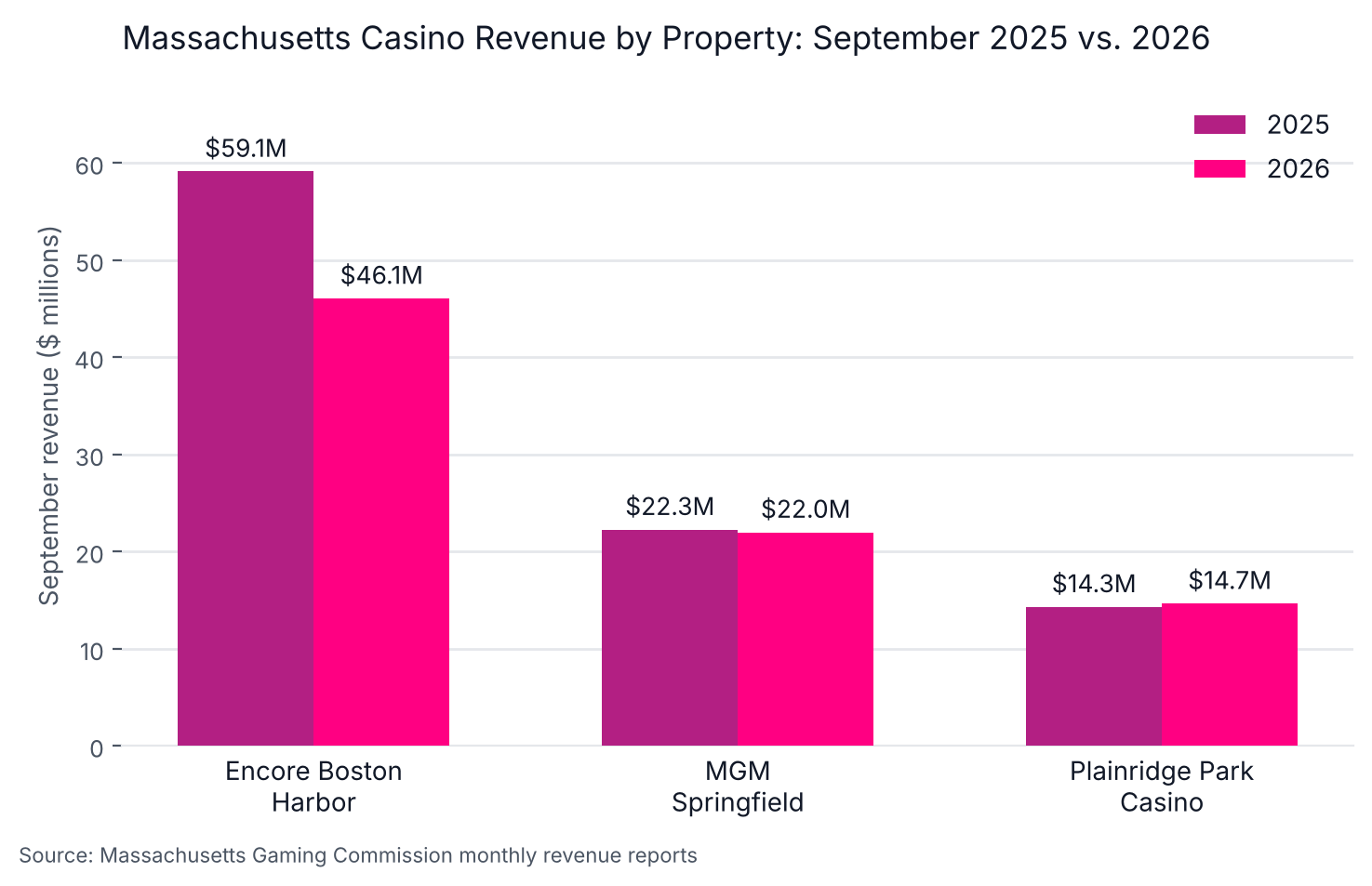
Massachusetts casino revenue by property, September 2025 vs. September 2026. Source: Massachusetts Gaming Commission.
Massachusetts Still Has No Regulated Online Casino, but Sweepstakes Sites Fill the Gap for Players
All three of these casinos remain land-based only. Massachusetts has never legalized iGaming, the regulated, real-money online casino play that's already running in states like New Jersey, Pennsylvania, and Michigan, so none of this month's revenue includes anything played from a phone or computer.
A bill that would have changed that, H.4431, was filed by state Rep. David Muradian in August 2025. It would have let the three existing casinos each launch up to three online casino brands under Gaming Commission oversight, and in the same stroke made it illegal to “operate, conduct, or promote” sweepstakes casino games in the state, with fines reaching $100,000 per infraction. That didn't happen. The Joint Committee on Economic Development and Emerging Technologies sent the bill to study on an 11-0 vote on March 16, 2026, a move that effectively shelves it until at least the next legislative session in 2027.
Because that bill stalled, Massachusetts currently has no statute specifically banning sweepstakes casinos, and sites built on that model, including Stake.us, Chumba Casino, McLuck, and Pulsz, continue serving Massachusetts players. Sweepstakes casinos run on a dual-currency system: players use one set of coins for free-to-play games and a second, Sweeps Coins, that can be redeemed for cash prizes and are available at no cost through mail-in or other no-purchase-necessary methods alongside paid coin packages.
Sean Ostrow of the Social Gaming Leadership Alliance testified to lawmakers that 300,000 to 400,000 Massachusetts adults already play sweepstakes or social casino games, and proposed a 6.25% tax on sweepstakes revenue, which he estimated could generate $25.6 million to $30 million a year for the state if lawmakers chose to regulate rather than ban the format.
Not everyone wants either path. State Treasurer Deborah Goldberg, who chairs the Massachusetts State Lottery Commission, opposed H.4431 during the hearing, warning that a licensed online casino market would compete directly with the Lottery's marketing and put at risk the roughly $1 billion the Lottery generates annually for local aid.
Meet The Author
Experience

Joss Wood has over a decade of experience reviewing and comparing the top online casinos in the world to ensure players find their favorite place to play. Joss is also a specialist when it comes to breaking down what casino bonuses add value and where to find the promotions you don't want to miss.
Read Full BioRelated News









Test Your Luck
Not Your Spam Filter
Sign up to receive emails and promotions from Casinos.com