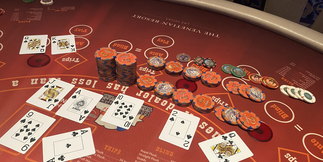
California’s new rules will ban traditional blackjack in card rooms starting April 1, forcing operators to adopt modified target-number games and change how dealer-banker roles work. (Photo: Arthurs Perspective / Alamy)
Late last week, the California Office of Administrative Law approved new table game rules for card rooms. Details were released Monday by Attorney General Rob Bonta and will take effect on April 1.
There are two changes affecting table games, primarily targeting blackjack. This is not much of a surprise, as the Department of Justice and stakeholders held numerous meetings last year.
Significantly, the new rules do not affect all California casinos. They only affect card rooms in the state, even if the venues market themselves as casinos.
For example, the rules apply to privately owned card rooms such as Bicycle Casino, but not the 86 tribal casinos, such as Yaamava, where table games will remain the same.
New Rules for Blackjack-Style Games in Card Rooms
According to the proposed rules, traditional blackjack is banned from California card rooms. Operators cannot explicitly use the words “blackjack” or “21.”
However, card rooms can offer blackjack-style games with the following rules:
- New target number: 21 cannot be used. The target may be 20, 22, or another designated number.
- No more "busting": Players may go over the target number, and the winners are the players whose numbers are closest.
- Natural blackjack is not an instant win: An ace and a 10-value card will no longer guarantee victory. It will simply be a strong hand.
- Players win if there’s a tie.
Casinos have experimented with many blackjack variants over the years, but these may be the strangest yet. Heather Guerena, chief counsel for Stones Gambling Hall in Citrus Heights, told The Sacramento Bee the rules could cut revenue by 40%.
New Player-Dealer regulations
Unlike traditional casinos, California card rooms cannot act as the banker or dealer. Instead, card rooms have relied on third-party proposition player services (TPPPs) to serve as dealers or bankers.
The new rules significantly restrict that practice. TPPPs are not banned, but there will be strict limits on how often they can act as the dealer-banker.
When the regulations take effect, the dealer must physically sit at the table, and before each hand begins, the card room must offer the dealer position to every player at the table. There must be at least two different dealers within 40 minutes, or the game will close if that rotation doesn't occur.
This rule will affect all table games at card rooms, not just blackjack-style games. Some less popular games could disappear entirely if there aren't enough players willing to rotate into the dealer role. Games will move more slowly because of the mandatory rotation.
The change may also deter players, as the banker must have a substantial bankroll. If the banker loses while the other players win, the banker must pay each winner from their own funds.
Kyle Kirkland, owner of Club One Casino in Fresno and president of the California Gaming Association, says his casino could lose 60% of its revenue due to these changes.
"It's just a dramatic, hard, 180-degree pivot in how the law is being interpreted, and that's what we have the problem with, that it's like, without any real reason, any visible harm to the public, we're having a 180-degree change in how these games are being interpreted, and it's devastating," Kirkland told CBS News Sacramento.
He believes “a $6 billion industry with 20,000 working families and around $500 million in state and local tax revenue would see at least a 50% reduction" as a result of the rule changes.
The Differences Between Card Rooms and Tribal Casinos
Regardless of the name on the building, card rooms and casinos are very different gambling establishments. Though many card rooms in California, like the Bicycle Casino or California Grand Casino, may include the word "casino" in their names, they are still legally considered card rooms.
California's casinos are operated by Native American tribes on tribal land, so they are regulated by tribal gaming commissions and federal authorities. They offer traditional table games such as blackjack, roulette, and craps. Slot machines and electronic table games are permitted at tribal casinos, and dealers actually work for the casino. Players compete directly against the casino, which pays winning players.
On the other hand, card rooms are privately operated businesses regulated by California’s Bureau of Gambling Control. They cannot offer slot machines, but they may offer poker, pai gow, baccarat, and blackjack-style games. While the dealer works for the card room, the banker's role must be filled by a player rather than the casino operator. Players compete against each other to win rather than competing against the house.
The differences matter. Recreational gamblers often prefer competing against the house rather than against another player who must risk personal funds.
Once the changes take effect on April Fool’s Day, they could be a boon for tribal casinos under California's new operating model for cardrooms.
Meet The Author
Experience
Marc was born and raised in New York City. He now resides in Las Vegas, where he’s been covering casinos and gaming for more than a decade. The gaming floor is the epicenter of Las Vegas casinos but so many great Las Vegas memories happen at bars, restaurants and other attractions. Finding the right combination goes a long way to a fun Las Vegas experience.Marc has been gambling since elementary school when he learned about sports betting and playing poker. Visiting casinos started a quest for knowledge from finding the best gaming odds and rewards to get the best bang for the buck on every visit.
Read Full BioRelated News









Test Your Luck
Not Your Spam Filter
Sign up to receive emails and promotions from Casinos.com