All In on Love: What an 1893 Marriage Medium Reveals About Risk, Odds, and Romance


Dating may have changed but the risks still mirror a gamble on love. (Image: Alan Evans/Casinos.com)
More than a century before swipe-right culture, a London journal promised something strikingly familiar: structured access to love, for a fee.
In December 1893, a publication titled Wedding Bells: A Social Journal & Marriage Medium entered Britain’s crowded matchmaking market. It billed itself as ‘For All Classes’ and pledged ‘Successful Results, not upon Large Fees before Marriage’.
The pitch sounds modern. Singles would pay to access a curated network of potential partners. There were no guarantees, only improved opportunity.
As dating platforms face growing scrutiny over subscription pricing, fake profiles, and emotional burnout, the Victorian example offers perspective. Monetised matchmaking is not a Silicon Valley invention. It is part of a longer commercial history built on risk, trust, and the promise of better odds.
A Guinea to Join: The Real Cost of Victorian Courtship
Membership to Wedding Bells cost one guinea in 1893. A guinea equalled 21 shillings, or £1.05 in pre-decimal currency. According to the Bank of England’s inflation calculator, £1 in 1893 is worth roughly £140 to £150 today, placing the joining fee at about £150 in modern terms.
That was not a token payment. It represented a meaningful financial commitment for working- and middle-class applicants.
The publication positioned itself against a backdrop of questionable matrimonial agencies. Late 19th-century newspapers frequently reported on intermediaries who charged large upfront fees and delivered few credible introductions. By emphasising ‘Successful Results’ and distancing itself from ‘Large Fees before Marriage’, Wedding Bells framed its model as more transparent in a lightly regulated marketplace.
Marriage in Victorian Britain carried economic and legal consequences far beyond romance. It shaped inheritance, legitimacy, property rights, and social mobility. For women in particular, reforms such as the Married Women’s Property Acts of 1870 and 1882 had only recently granted married women the right to retain earnings and own property independently.
In that context, paying to access vetted introductions was not frivolous. It was strategic.
Gatekeepers, Letters, and No Guarantees
The matchmaking process moved slowly. Correspondence took place by post, often over weeks. Editors or agents screened applicants and facilitated introductions.
A membership fee bought entry into a system, not a spouse.
That structure remains familiar. Today’s subscription dating platforms charge monthly or annual fees for enhanced visibility, algorithmic matching, or messaging privileges. The language has evolved, but the transaction is similar: pay for better positioning, accept uncertainty.
The modern online dating industry is now worth an estimated £2 billion annually, and is now so important to the British economy that the Office of National Statistics have recently added it as a category on their site, owned by HM Government.
Paying More Doesn’t Guarantee Compatibility, it Increases Exposure
Land-based and online casinos operate on a related principle. Players understand they are paying for participation in a system governed by probabilities. Dating platforms are not gambling products, but both rely on a shared psychology: hope, perceived control, and the willingness to invest money for a potentially life-changing outcome. Take the piece we did on Ikea and Netflix recently.
Over at Netflix, managers reportedly hand new hires a metaphorical “bag of betting chips.” They’re expected to place those casino chips, to make bold choices and take calculated risks.
By year’s end, Netflix leaders look back at those bets. If every decision succeeded, it means the employee didn’t gamble enough. If none worked, their judgment’s off. The goal is to hit that sweet spot between caution and chaos, much like a skilled blackjack player knowing when to double down.

Why People Pay for Uncertain Outcomes
Research in behavioural economics shows that people tolerate higher financial risk when emotional rewards are significant. Decisions tied to identity, belonging, and long-term stability often outweigh purely rational cost-benefit calculations.
In Victorian Britain, a respectable marriage could secure financial protection and social legitimacy. Today, users pursue compatibility, shared values, and long-term partnership. The framing has changed. The motivation has not.
The enduring appeal of paid matchmaking raises practical questions for modern platforms:
• How should companies balance recurring subscription revenue with users’ emotional vulnerability?
• How is uncertainty communicated without undermining trust?
• What safeguards protect against fraud, impersonation, and data misuse?
• And how should expectations be managed so users understand they are paying for access, not a guaranteed result?
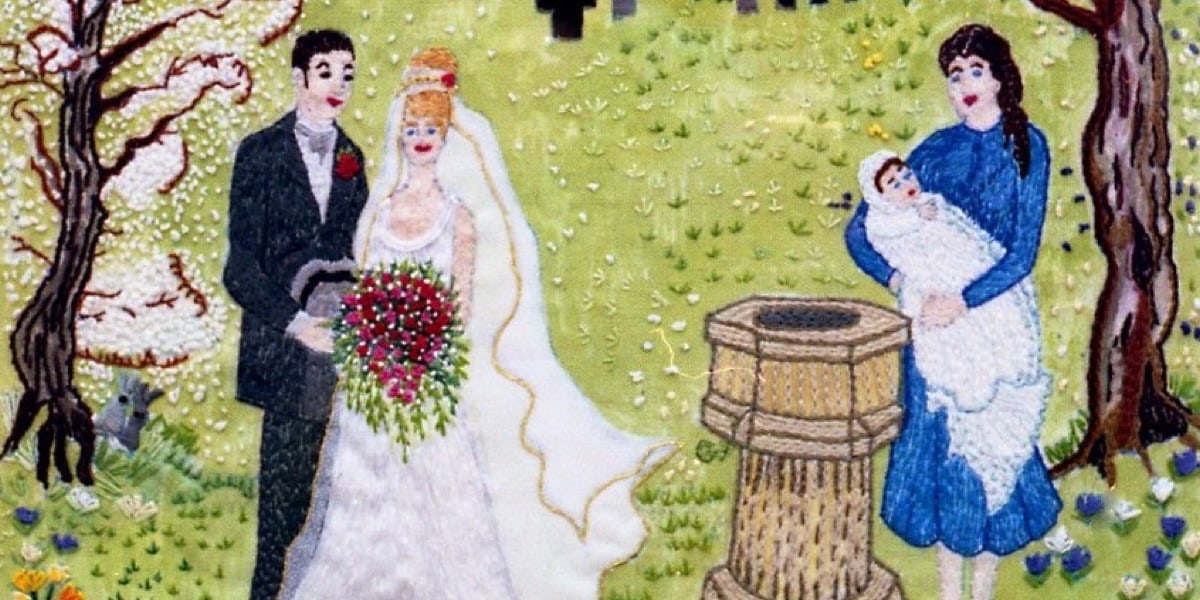
An old wedding embroidered on cloth. (Image: Alan Evans/Casinos.com)
The Business of Hope, Then and Now
The launch of Wedding Bells in 1893 underscores a broader reality. Paying intermediaries to improve romantic prospects predates apps, algorithms, and smartphones.
What has changed is scale and speed. Victorian singles relied on printed journals distributed periodically. Modern platforms connect millions of users instantly across cities and continents.
The core exchange, however, remains intact. You pay to participate. You accept uncertainty. You pursue a meaningful outcome. Technology changed the interface. It did not eliminate the risk. In that context, paying to access a curated network of prospective partners was less frivolous than strategic. Technology has changed, but the structure remains familiar: invest more, improve your chances, but accept that outcomes remain uncertain.
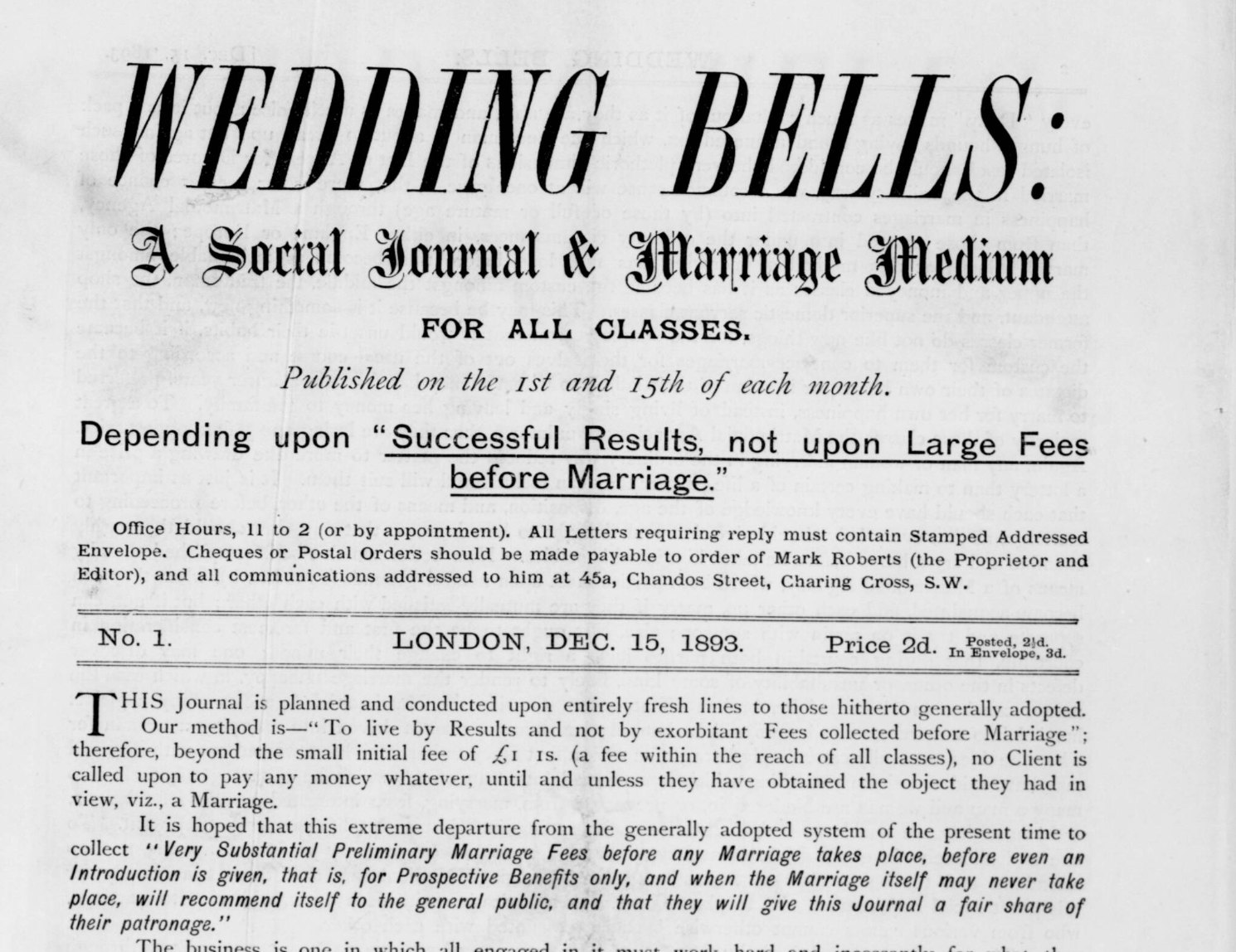
The original advert in the publication, Wedding Bells 1893. (Image: British Newspaper Archive)
Meet The Author
Experience

 News Writer
Most of my career was spent in teaching including at one of the UK’s top private schools. I left London in 2000 and set up home in Wales raising four beautiful children. I enrolled at University where I studied Photography and film and gained a Degree and subsequently a Masters Degree. In 2014 I helped launch a new local newspaper and managed to get front and back page as well as 6 filler pages on a weekly basis. I saw that journalism was changing and was a pioneer of hyperlocal news in Wales. In 2017 I started one of the first 24/7 free independent news sites for Wales. Having taken that to a successful business model I was keen for a new challenge. Joining the company is exciting for me especially as it is a new role in Europe. I am keen to establish myself and help others to do the same.
Read Full BioRelated News


Test Your Luck
Not Your Spam Filter
Sign up to receive emails and promotions from Casinos.com