The Blurred Line Between Betting and Trading Just Got a Lot Harder to Ignore


President Trump under the spotlight as traders make millions. (Image: AC News Photo/Alamy)
The question that has been haunting prediction markets for months, what happens when someone bets with knowledge nobody else has, moved from theory to front page news this week. And this time, it was not a prediction market at all. It was the oldest financial market in the world.
Traders placed approximately $320m in oil contracts that would profit from a falling oil price in the minutes before US President Donald Trump announced a pause on planned strikes against Iranian energy infrastructure. Minutes later, the oil price fell 14%. The scale and timing of the trades have drawn scrutiny from analysts and regulators on both sides of the Atlantic, and reopened a debate this industry has been tracking closely: where does informed betting end and criminal insider knowledge begin?
What the Trading Data Shows
Market data reviewed by the BBC shows trading volumes on crude oil futures spiked sharply around 15 minutes before Trump posted on his Truth Social platform at 07:04 Eastern Time on Monday, stating that the US and Iran had held productive talks toward a full resolution of hostilities.
Between 06:49 and 06:50 ET, the number of WTI crude oil contracts on the New York Mercantile Exchange rose from 734 to 2,168, representing approximately $170m. A near-identical spike appeared in Brent crude contracts over the same two-minute window, where volumes climbed from 20 to more than 1,650 trades, worth around $150m.

Similar surges were recorded in futures contracts tied to the S&P 500 and Euro Stoxx 50, indicating traders were simultaneously positioning for rises in major US and European stock indices, positions that would profit directly from an easing of Middle East tensions.
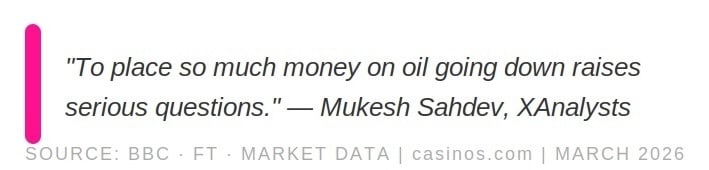
Mukesh Sahdev, chief oil analyst at XAnalysts, told the BBC the activity was clearly irregular. "At that time, there were no indications that any serious talks had been taking place between the US and Iran. So to place so much money on oil going down raises questions."
Rachel Winter, a partner at Killik & Co, noted the pattern had already prompted speculation in financial circles, adding that any conclusion about wrongdoing would require formal investigation
Iran's government moved swiftly to deny the substance of Trump's post. The Speaker of Iran's parliament, Mohammad-Bagher Ghalibaf, said the reports of productive talks were being used "to manipulate the financial and oil markets".

Oil prices partially recovered following those comments. The White House said it did not "tolerate any administration official illegally profiteering off of insider knowledge."
The BBC confirmed it had contacted both the US Commodity Futures Trading Commission and the UK's Financial Conduct Authority, though neither has confirmed a formal investigation.
This Story Has Been Building for Months
For those following the prediction markets space, Monday's events will feel like a familiar plot in a new setting.
In January, a single account on Polymarket turned a $32,537 stake into more than $436,000 by correctly wagering on Venezuelan president Nicolás Maduro being seized by American forces, hours before the event became public. The timing drew immediate suspicion that the bettor had access to advance knowledge. No formal action followed.
That episode sat at the heart of panel discussions at this year's NEXT.io Summit in New York, where operators from across the land-based and online casino industry identified the same vulnerability at the core of prediction markets: anonymous participation, policy-sensitive outcomes, and no consistent rulebook.
The question being asked this week about oil futures, did someone know something they should not have is the same question regulators and journalists have been asking about prediction markets for the better part of a year.
Broadcasters including Emily Maitlis at The News Agents have raised the issue publicly, questioning whether individuals with advance knowledge of policy announcements could use prediction markets to profit without accountability.

Emily Maitlis and Jon Sopel said they believe Trump's main goal in making the peace talk statement was to try to “magic up” what he would like to happen in Iran, rather than being based in any reality.
Maitlis said: “The alarm is being sounded over suspicions of insider trading. There is a question whether some people are getting filthy rich on the back of an announcement that probably wasn't even true.”
What the UK Has Already Decided
While the United States continues to contest the question in courtrooms across more than 20 states, the United Kingdom has already drawn its line, and we covered it when it happened.
In a blog post published on 4 February 2026, Brad Enright, the Gambling Commission's director of strategy, confirmed that prediction markets would fall under existing UK gambling law if offered to consumers in Great Britain. Any operator wishing to run one would need a betting intermediary licence, the same category that governs exchanges such as Betfair. Operating without one is a criminal offence.
That ruling effectively closes the regulatory gap that has made prediction markets so contentious in the US, where platforms including Kalshi and Polymarket are fighting state-level lawsuits over whether their products constitute federally regulated derivatives or unlicensed gambling.
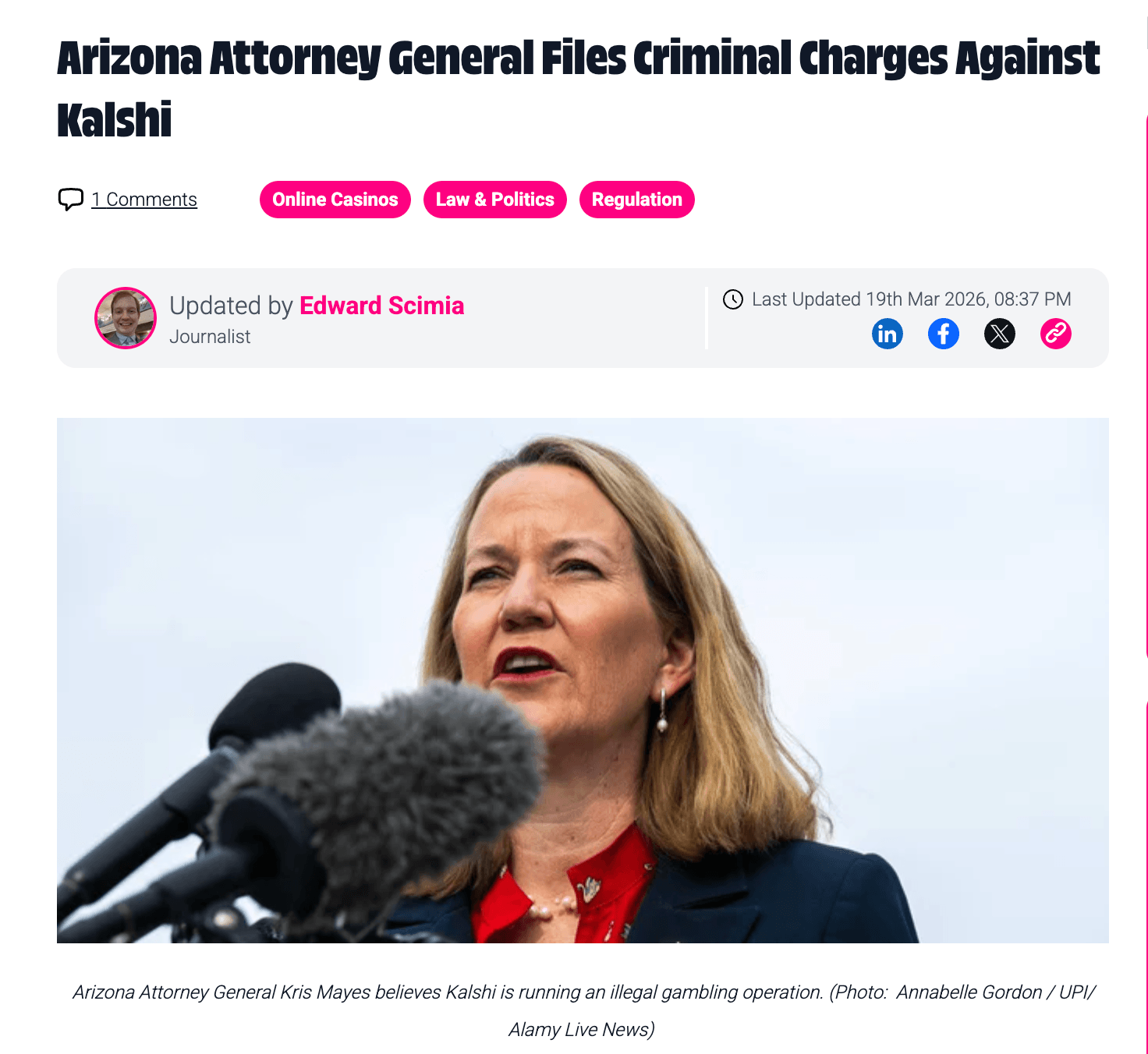
In January 2026, CFTC Chairman Michael Selig withdrew a proposed rule that would have banned sports and political event contracts entirely, committing instead to new rulemaking, leaving the legal position more unsettled than ever. Arizona's attorney general has since filed criminal charges against Kalshi, accusing it of operating an unlicensed gambling business. Kalshi contests the charges.
The UK's position matters here not just as regulatory context, but as a model.
The UK Gambling Commission has made clear that prediction markets meeting the statutory definition of gambling require a licence, regardless of how operators label them.
The only recognised exception is spread betting, regulated by the FCA. The Commission also cautioned that the US prediction market boom may not replicate in Britain, where licensed betting exchanges have offered outcome trading for decades following regulation dating back to 1961. Unlicensed operators targeting British consumers have been warned enforcement action will follow.
By treating prediction markets as gambling products from the outset, the Gambling Commission has ensured that operators, participants, and the information they act on are subject to the same scrutiny applied to any licensed betting exchange. The kind of anonymous, advance-knowledge positioning that is now being asked about in oil markets would, on a UK-licensed prediction market, be a matter for the same regulators already investigating financial misconduct.
The Convergence Nobody Can Ignore
Three forces are now converging to put both the gambling industry and financial regulators under pressure simultaneously: the rise of prediction markets, AI-powered betting tools, and the economic fallout from US-Israeli military strikes on Iran that began on 28 February 2026.
Together, they are forcing a reckoning with a question the industry has long deferred: where does gambling end and financial trading begin, and who gets to decide?
This week's oil trades did not happen on a prediction market. But they raised exactly the question prediction markets were built around. The line between the two has never looked thinner.
Meet The Author
Experience

 News Writer
Most of my career was spent in teaching including at one of the UK’s top private schools. I left London in 2000 and set up home in Wales raising four beautiful children. I enrolled at University where I studied Photography and film and gained a Degree and subsequently a Masters Degree. In 2014 I helped launch a new local newspaper and managed to get front and back page as well as 6 filler pages on a weekly basis. I saw that journalism was changing and was a pioneer of hyperlocal news in Wales. In 2017 I started one of the first 24/7 free independent news sites for Wales. Having taken that to a successful business model I was keen for a new challenge. Joining the company is exciting for me especially as it is a new role in Europe. I am keen to establish myself and help others to do the same.
Read Full BioTest Your Luck
Not Your Spam Filter
Sign up to receive emails and promotions from Casinos.com