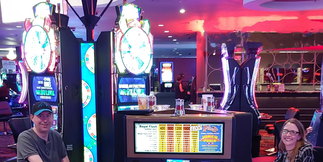
I’m about to get paid for a winning hand of Pai Gow at Park MGM! (Photo: Marc Meltzer / Casinos.com)
LAS VEGAS — Whether it’s on the casino floor, at dinner or at shows, visiting Las Vegas has always been about getting the most out of your money. That becomes even more important during uncertain economic times.
As someone who has always visited on a budget, both large and small, I’ve found some “hacks” over the years to maximize value and fun. There are plenty of dining deals and happy hours, but it is a bit more challenging in the casino, where odds have worsened over the past 20 years or so.
I discovered Pai Gow Poker about 10 years ago. I didn’t know it at the time, but it has changed how I gamble in Las Vegas.
Craps is my favorite casino game, but, like all casino games, it can be volatile in the short term. While the base game has a low house edge for the casino, wins and losses can happen quickly in a session.
That volatility can make the game a lot of fun, but it also means a player with a small budget can bust out quickly. Leaving the table after just a few rolls is a bummer.
Gambling is entertainment for me. I don’t mind “boring” casino games at times. My bankroll can last a little longer, which allows me to spend more time gambling and possibly hit a hot streak and walk away a winner. If nothing else, I spend more time at the table.
Today, I play Pai Gow Poker more than any other table game in Las Vegas. I still use this name because I have been playing it for years. But the version dealt most often in casinos today is Face Up Pai Gow.
High volatility is not your friend if you want to maximize your dollars and time spent gambling in Las Vegas.
Why Pai Gow Poker Works for Budget Gamblers
I discovered Pai Gow Poker wandering around Mandalay Bay with a friend. The players were having a blast and drinking – a lot.
I like fun, and I like drinking, so my friend and I stood around watching the table. After a while, we still didn’t totally know how to play, but we threw down a $100 buy-in.
On the downside, that was only good for four hands with a $25 minimum bet. On the upside, we saw there were a lot of push hands where players didn’t lose or win, so the money lasted a while.
We had a great time with our small bankrolls, but eventually we lost our money. We were hooked and wanted to learn more about Pai Gow because our money could last longer on the Strip, where odds are bad for most games and bankrolls disappear quickly.
Since we had small bankrolls, we headed off the Strip to Gold Coast to really learn how to play the game. Back then, the minimum bet was only $5, so we had money to play for a while.
After about four hours of learning how to play and drinking, we probably tipped the cocktail waitress and dealers more than we lost at the table. It was one of those Vegas nights that shaped how I enjoy the city.
The challenge moving forward was finding friends willing to explore this new game (to me). Nowadays, I play Pai Gow Poker more than any other table game, and friends often join me because they also want to maximize value and fun in Las Vegas.
Volatility vs. House Edge: What It Means for You
Volatility and house edge matter when a player wants to maximize their bankroll and time spent gambling. The lower both are, the longer a bankroll should last. Of course, anything can happen in the short term.
In layman’s terms, volatility, also called variance, is the ups and downs of a gambling session. These are the positive and negative swings a bankroll can have during a session.
High volatility often comes with bigger but less frequent payouts. Players can think of this as a boom-or-bust session where they can win or lose big quickly.
Low volatility comes with frequent small wins, so a bankroll lasts longer. While less exciting than big jackpot wins, these smaller payouts can keep a player in the game longer.
Playing a high- or low-volatility game is a personal preference. As someone who likes to gamble, drink and hang out, I prefer a game where my money lasts longer so I can play more.
House edge is just as important as a game’s volatility. It is the percentage of each bet that the casino expects to keep over the long run.
In theory, the lower the house edge, the slower a player will lose their bankroll. Again, anything can happen in a single session.
A player can maximize both bankroll and time spent gambling by choosing a game like Pai Gow Poker, which has a low house edge and low volatility.
How to Play Pai Gow Poker (Without Stressing Out)
Playing Pai Gow Poker is confusing at first, but it becomes easy after a few games. Unlike some poker variants, this is a game where the player goes against the dealer.
The game uses a standard 52-card deck plus a joker. After all players place their wagers, they are dealt seven cards to make a five-card hand and a two-card hand.
In today’s Face Up Pai Gow, the dealer’s cards are face up while all players’ cards are face down. The dealer acts first and sets their two hands face up according to rules known as the “house way.”
If the dealer’s best hand is an ace high, the game is a push, and the wager is given back to the player. The only active wagers for players are bonus or side bets.
Next, players set their two hands. The five-card hand must be higher than the two-card hand.
Sometimes the “house way” isn’t the best way to play a hand. Since players can see the dealer’s hand, they can arrange their cards optimally to try to win. The only rule is that the five-card hand must be higher than the two-card hand.
- The player wins the even-money bet if both hands are better than the dealer’s.
- The player loses if both of the dealer’s hands are better.
- The game is a push, and the wager is returned if the player wins one hand and loses the other.
The house edge for Face Up Pai Gow is about 1.8 percent. Mathematically, a player will lose $1.80 for every $100 played.
A player will win one hand and lose the other in about 40% of hands dealt. The dealer will have an ace high about 9% of the time, and these games will also end in a push.
BQIn Face Up Pai Gow, just under half of the hands result in a push.
This is how Pai Gow Poker allows players to spend more time at the tables in Las Vegas. The net result isn’t always a win because this is gambling, but the time spent playing, drinking and carousing with new and old friends is what makes Las Vegas fun.
Casinos also offer multiple side bets and progressive wagers, which come with a higher house edge starting at 7% for those who want a little extra action.
The Downsides to Know Before You Play
While I love Pai Gow Poker, I understand that it isn’t for everyone. The pace suits me perfectly, but it can be slow or boring for those who enjoy games that move quickly or offer the chance for big payouts.
Casino operators aren’t dumb, and they know people play Pai Gow Poker for the low house edge and the frequent pushes. The minimum bet is often on the high side, often $25 during weeknights on the Strip and higher on weekends.
Slots have a high house edge, and players can earn casino reward points and tier credits quickly. Pai Gow Poker is just the opposite. The game has a low house edge and offers limited rewards.
Pai Gow Poker has changed over the past few years. Most games are now Face Up Pai Gow. The game is mostly the same, but some changes have reduced player benefits.
Players can no longer bank games, which previously allowed them to take on the house edge. While small, any advantage for the player is valuable.
If the dealer has an Ace high, for example, the hand is a push. This was a beatable hand in the original incarnation of the game. According to gaming analyst Michael Shackleford, that rule is essential to the house maintaining an advantage in the game. Without the Ace-high push in Pai Gow, then the player could have a 3.98% edge. That would make it the best odds for a player in the casino.
Final Thoughts: Pai Gow as a Vegas Value Play
Pai Gow Poker isn’t about chasing life-changing jackpots – it’s about getting the most entertainment for your money in a city where dollars can disappear fast. The game’s low volatility and frequent pushes mean you can sip cocktails, laugh with friends, and keep the cards moving for hours without burning through your budget.
Whether you’re a seasoned gambler or just looking to stretch your bankroll in Las Vegas, Pai Gow Poker offers time, value, and plenty of fun – a combination that’s becoming all too rare on the casino floor. In a city built on fleeting moments, that’s a win in itself.
Meet The Author
Experience
Marc was born and raised in New York City. He now resides in Las Vegas, where he’s been covering casinos and gaming for more than a decade. The gaming floor is the epicenter of Las Vegas casinos but so many great Las Vegas memories happen at bars, restaurants and other attractions. Finding the right combination goes a long way to a fun Las Vegas experience.Marc has been gambling since elementary school when he learned about sports betting and playing poker. Visiting casinos started a quest for knowledge from finding the best gaming odds and rewards to get the best bang for the buck on every visit.
Read Full BioRelated News
![[Video] Elon Musk’s Boring Company Drilling Las Vegas Tunnel Network Under Westgate Casino](https://www.casinos.com/cdn-cgi/image/f=webp,q=86,fit=cover,g=auto,w=323,h=162/https://objects.kaxmedia.com/auto/o/192479/97eb340d1f.jpeg?v=70fa21fd123d0abbd6c544fe6094f9e093fc4b50)








Test Your Luck
Not Your Spam Filter
Sign up to receive emails and promotions from Casinos.com