Superstition & Gambling: Why Luck Rituals Hook Us


Picture a sizzling Saturday night in vintage Las Vegas, 1960s, the neon glow of the Sands Casino painting the air in electric pinks and blues. A seasoned punter leans over a slot machine, fingers tracing a lucky dime for good fortune. He times his pull with a steady breath, tapping the cabinet twice before the reels whirl. They halt just shy of a jackpot – a near-miss that sparks a rush. Was it the ritual, or pure chance? For him, the act seals the deal, prompting another go, another tap, another shot at glory.
This scene encapsulates superstition in gambling, the belief that rituals can bend luck in a world governed by odds. From the glitzy floors of Vegas to Britain’s seaside arcades, punters weave actions and objects into a grand fabric of hope, challenging the house’s mathematical dominance. But why does this thrive? It’s a potent blend of uncertainty, intermittent rewards, and sensory cues that draws us in.
Uncertainty is the gambler’s muse. Every spin, card, or roll plunges into the unknown, nudging our brains to hunt for patterns, a survival instinct from when spotting trends meant survival. Intermittent rewards, like the odd win amid losses, ignite the brain’s dopamine system, conditioning us to repeat rituals. Psychologist B.F. Skinner’s experiments with pigeons pecking for random food pellets mirror this, a behaviour punters echo with every near miss. Sensory cues – the clink of coins, the roulette wheel’s hum, or the dealer’s shuffle – heighten the magic, transforming the casino into a stage where luck feels within reach.
This illusion of control fuels rituals: timing slot spins, tapping cabinets, or blowing on dice before a throw. It’s less about skill and more about ‘skill-feel’ – the comforting idea that personal action shapes fate. Yet, luck remains elusive, a slippery notion punters believe they can sway, from dodging Friday the 13th bets to clutching good luck charms.
In 2025, with online gambling alone surging to £100 billion globally per Statista, these beliefs adapt, merging tradition with digital allure. This article explores why luck rituals captivate, delving into their origins, cultural twists, and practical insights.
“Back before Vegas, before Monte Carlo, before even dice had corners, the Greeks were chuckin’ sheep knucklebones. Four sides, no mercy. Before every toss, players poured out a little vino for Tyche, the goddess of luck, and Hermes, patron saint of tricksters and fast talkers. A bad roll? The gods were ticked off. A lucky streak? Time to drop a fig as tribute. Bribe the divine, butter up fate, and hope the house upstairs played fair.”

The Gambler's Fallacy
We can’t really go much further without addressing the Gambler’s Fallacy. The Gambler’s Fallacy is the mistaken belief that random events must self-correct after a series of one outcome, and it is an enormous driver of superstition in casinos.
For example, players assume a run of red in roulette means black must be due next, or five losses in blackjack mean a win is imminent. This ignores the independence and isolation of each event. Probability resets every hand, spin, or roll, and the house edge remains unchanged. In other words, past results do not influence future ones in fair games.
The term was coined in 1913 after an infamous incident at Monte Carlo Casino. On 18 August, the roulette wheel landed black 26 times in a row. Bettors lost millions wagering on red, expecting balance, highlighting the fallacy. Earlier versions appeared in 18th-century probability texts by mathematicians like Pierre-Simon Laplace, but the name stuck due to the Monte Carlo case. It is now a core concept in behavioural economics and gambling studies.
Gambling Superstitions
So we all know that gambling and superstition go hand-in-hand, but how might it manifest in specific games? You may actually be surprised at how specialist superstition can be.
Slots
Tapping
Tapping is a common superstition among slot players. 'Tapping' is the polite term for it, but many slots players call people who do it as 'button slappers,' and not very affectionately either. They strike the machine cabinet with fingers, believing it influences the reels. The action is repeated, often in sequences like two taps, to attract wins or avoid losses. This stems from the illusion of control over random outcomes. Players associate the physical act with past successes, despite no mechanical effect.
Studies show such rituals increase playtime by 15%, as they create a sense of involvement. It provides psychological comfort but does nothing to alter probabilities or impact the house edge.
Seat Selection
Seat selection involves choosing specific chairs at slot machines based on perceived luck. Players pick seats where previous jackpots occurred or avoid those near exits due to supposed bad energy.
This superstition relies on the belief that location affects outcomes, but there is little research to back it up. Myths persist, of course, about casinos setting different RTPs for different machines in the same bank of identical games, but this one remains very much in the realm of superstition for now.
Near-Miss Chasing
Near-miss chasing occurs when players continue to play after reels stop one symbol short of a payout. They interpret this as a sign of impending win. This leads to extended sessions and additional bets based purely on the belief that the machine is ‘due’.
It is essentially an illusion of progress, as there is no logical reason to expect a machine to tease. Of course, serious slots players know that every spin is independent of each other, but it doesn’t always feel like that whilst you’re sitting in the chair.
I remember vividly playing Dragon Link at the MGM Grand once and the Major Jackpot ball kept on going through the reels. The flash of green was happening so often my brain was telling me it ‘wanted’ to land. It didn’t, of course, no matter how much cash I kept shovelling in. Let’s not talk about it again (even when I make the same mistake again, which I promise you I will.)
“When the ancient Romans rolled the bones, they did it with style and superstition. The law said any wager gone wrong cost you four times the loss. So gamblers got crafty, using little clay chips instead of coins to dodge the fines. In Rome, luck rode a spinning wheel with no brakes. Sweet-talk Fortuna, and maybe she’d smile. Cross her, and your chariot bets were heading straight for the wall.”
Roulette
Dealer-Following
Dealer-following is a thing in all table games, and it’s the practice of betting based on a croupier’s recent results. In roulette, players select dealers associated with wins, believing their handling influences the ball. Tips are given to maintain the perceived streak.
It impacts nothing, of course. In roulette especially, the dealer is unable to impact anything. The odds are the odds and no amount of tracking dealers across shifts will change them. People still do it, though. In fact, some people swear by it! Delusion, desperation, confirmation bias, or something in it? Try it for yourself I guess, but curb your expectations (and maybe lower your bet) when you do.
‘Due’ Colours/Numbers
‘Due’ colours or numbers refer to betting on outcomes believed overdue after runs. Players wager on red after black sequences or specific numbers after absences. This assumes self-correction in random events. It’s also why casinos have digital boards showing ‘hot’ and ‘cold’ numbers to encourage such thinking.
As discussed, believing a result is ‘due’ is the cornerstone of the Gambler’s Fallacy, and was what actually created and popularised the term in gambling lore.
Blackjack
Third-Base Myths
The third-base superstition in blackjack centres on the player who acts last before the dealer. This position on the table is called third base in standard layout. Superstition holds that the third-base player controls the table’s luck as it’s their hit or stand that causes the dealer to bust or win.
For example, if that player hits and takes a card the dealer needed to bust it is seen as ruining the round. But if they stand and that forces the dealer to bust, then it’s good news for everyone. This belief assumes one player’s choice affects independent card draws. In reality, each hand is separate, all players affect the deck no matter where they sit, and probabilities do not change. Sometimes, though, it’s nice to have someone to blame for your losing hands.
Lucky Cut Cards
In blackjack, a cut card is a special card, often a plastic or coloured indicator, that gets inserted into the deck or shoe after shuffling to mark the point where the dealer will stop dealing. It's a standard security measure to prevent cheating, like card counting or marked cards, and ensures the game ends after a predetermined number of hands (typically 75-80% of the shoe).
The dealer shuffles the deck, then offers it to a player (usually the first or a designated person) to ‘cut’ by placing the cut card at a random spot. The deck is then reassembled with the cut card facing up, and dealing begins from the top. Once the cut card appears during play, the dealer reshuffles for the next shoe.
Over the years, whole superstitions have grown around cut cards. Many gamblers consider brand new cut cards unlucky, whilst tatty old ‘worn in’ used ones to be favourable. Some have a ‘lucky’ colour too. There is no logic to it, but enough people swear by it to make you wonder.
Poker
Lucky Hoodies
Lucky hoodies are a common poker superstition and it refers simply to players wearing the same sweatshirt or jacket during winning sessions as they believe it retains good luck. Just in case ‘luck’ is washable by soap, the clothing is often not washed between games in an attempt to preserve the streak.
It’s an ultimately understandable practice based on association with past success, but it has no provable effect on results. It does, though, create confidence, which many poker players would argue is an important weapon to carry.
Card Protectors
Card protectors are objects placed on hole cards to prevent folding by mistake. For those unaware, ‘hole cards’ are the two face down cards dealt in games such as Texas Hold’em. Superstition, though, treats the card protectors as lucky charms, with players often using coins, chips, or figurines from previous wins.
The belief is that the protector influences hand strength. This is unrelated to EV. EV is calculated from fold equity and bet sizing. In American poker rooms, custom protectors are common. The item offers psychological comfort.
There is, of course, nothing to back that up, but that doesn’t necessarily mean it’s not worth a try, right?
Baccarat
Squeezing
If you have ever watched a Vegas Matt YouTube vlog, you will be familiar with squeezing. It’s the slow reveal of card edges in baccarat. Players bend corners to peek at values, believing tension builds luck. Be advised, though, that it’s mainly only high-stakes tables that allow it.
Remember, baccarat is a game devoid entirely of skill. After the cards are dealt, there are absolutely no decisions for the player to make. The popularity of squeezing, then, may just be players shoehorning engagement into a game that otherwise they watch rather than play. Whatever the reason for its popularity, it definitely seems to increase player enjoyment, which is what gambling is all about at the end of the day.
Road Maps
Baccarat road maps, also called scoreboards or trend charts, are visual grids displayed at casino tables (especially in high-stakes rooms like those in Las Vegas or Macau). They track outcomes of each hand in a shoe to help players spot patterns. Red circles/dots mark Banker wins, blue for Player wins, green slashes/lines for Ties.
It is similar to the ‘due’ numbers and colours in roulette, in that baccarat road maps create the illusion of patterns where none actually exist. Still, try telling that to a baccarat player!
Skipping Hands
Skipping hands means sitting out after losses and it is based on nothing but superstition. Players get on losing streaks and decide to wait for a ‘better’ or luckier shoe.
Lost Gambling Traditions
Defunct superstitions in land-based gambling once added colour and ritual to the casino floor, but many have faded with time. Players used to kiss or blow on dice before a craps roll, believing it transferred luck to the cubes. Dealers in faro games carried tiger-bone cases as good luck charms for good hands, while keno runners marked tickets with goose quills thought to carry fortune. In blackjack, punters insisted on cutting the deck with a personal coin or heirloom card to influence the shuffle.
These customs are often tied directly to physical objects and manual processes, creating a sense of personal agency in random games. However, technology and regulation have driven their decline. Automatic shufflers now often replace hand cuts in blackjack, for example, while health rules can impact dice handling in craps. There were once many superstitions around cigarettes in casinos, but now many casinos ban smoking.
Similarly, modern casino security demands standardised equipment, leaving little room for players’ custom talismans. And, of course, casinos prioritise speed and fairness over tradition, so many of these once-vibrant practices now exist only in history books or vintage photos. The shift reflects a move from tactile superstition to streamlined play, where the house edge rules without interference.
How Culture Influences Superstition
Culture breathes life into superstitions, turning the everyday into a tapestry of omens and charms. Some societies see luck as a force to wrestle and shape; others view it as a river carved by ancestors or gods, to be navigated with respect. This divide between fate negotiable (a door you can nudge open with the right gesture) and fate destined (a path etched in the stars or soil) influences everything from a morning greeting to a midnight wish. Across continents, these beliefs weave through rituals, numbers, and symbols, offering comfort in uncertainty.
“Back in 1876 in Deadwood, Dakota Territory, Wild Bill Hickok was sittin’ at Nuttal & Mann’s Saloon when a bullet cut his luck short. In his hand? Aces and eights, both black—the “Dead Man’s Hand.” From that day on, any cowboy worth his whiskey folded that combo faster than a crooked dealer. Out here in the saloons of Deadwood, where guns spoke louder than the dealer, superstition wasn’t just habit—it was insurance. Charm fate, or end up facin’ it at high noon.”
Western cultures: From the bustling streets of New York to quaint English villages, luck is treated like a wild card you can play smartly. People cross fingers for good fortune, knock on wood to ward off jinxes, or hang horseshoes for protection. The number 7 sparkles with mystical promise; 13 casts a long shadow of misfortune. A broken mirror spells seven years' bad luck, but finding a penny heads-up flips the script. Luck here is negotiable, a personal pact with chance and sealed by action and optimism.
Chinese tradition: Luck is framed as flowing qi, an energy you align with through harmony, not force. Red lanterns are hung to invite prosperity, the number 8 echoes abundance (due to the Chinese word sounding like "wealth"), while 4 whispers "death" and is shunned. Jade pendants and feng shui arrangements channel this current, turning homes into fortresses of fortune. Luck is negotiable, a dance with the cosmos where balance brings bounty.
South Asian: Beliefs entwine Hindu karma with Islamic taqdir, seeing luck as a ledger of deeds softened by devotion. Tie a black thread for protection, whisper a mantra to Lakshmi for wealth, or touch wood to ground fleeting hopes. Fate is semi-negotiable as past lives set the board, but prayer and piety can redefine the game.
Japanese culture: Equilibrium between Shinto spirits and Buddhist serenity is sought in the pursuit of luck in Japanese culture. A maneki-neko cat beckons fortune from shop windows, a sprinkle of salt purifies against evil. The number 4 mimics "death" in sound and is skipped in buildings but 7 is coveted. Luck is negotiable through rituals of respect – bow to the kami, keep spaces uncluttered, and harmony flows.
Middle Eastern cultures: Rooted in Islamic wisdom, luck is cast as barakah – a divine blessing to receive humbly. Charms, such as blue beads, are subtle but are thought to assert control. Luck is mostly destined, a gift to embrace with gratitude rather than find randomly.
African traditions: For many African cultures, luck is seen as a communal thread woven by forebears. In Yoruba lore, for example, offerings to Orishas like Oshun coax prosperity, while Zulu healers consult bones for guidance. The number 7 often signals good fortune, tied to creation myths, but 13 may evoke unease in some regions. Black cats or cracked mirrors herald misfortune, but objects like cowrie shells or juju amulets deflect curses. Luck is negotiable through rituals yet deeply destined by lineage and harmony with the unseen world.
All these global threads reveal why a rainbow might mean riches in one land and rain in another.
Lucky Numbers
Certain numbers become associated with good or bad luck due to salience, psychological reinforcement, and cultural influence. Salience occurs when a number stands out through frequent exposure or memorable events, especially those embedded in religion, making them easier to recall. Reinforcement then happens when a win or positive outcome coincides with the number, strengthening the belief via dopamine release.
Then comes media, the great amplifiers. Hollywood peddles 7 as the jackpot king in films like Ocean's Eleven, while fairy tales spin it as magic (seven dwarves, anyone?). In ads, 777 screams slot success; in news, it's the "lucky seven." Unlucky numbers get the villain edit too – 13 in horror flicks, 4 in Asian dramas evoking death. These narratives aren't random; they're rooted in history and language, passed down like heirlooms.
A 2023 study in the Journal of Cross-Cultural Psychology found 68% of people worldwide report a "lucky number," shaped by childhood stories and media exposure. In gambling, this sticks harder: punters bet on 7 at craps, convinced it's charmed, ignoring the 1:6 odds. Salience spots it, reinforcement rewards it, culture cements it, and all combine to turn digits into destiny's dice.
| Culture | Lucky Number (Why) | Unlucky Number (Why) |
|---|---|---|
| Western (U.S./Europe) | 7 (Biblical creation in 7 days; appears in myths, lotteries, and media as "complete" or divine) | 13 (Last Supper's 13th guest Judas; Norse myth of 13th god bringing chaos; Friday the 13th folklore) |
| Chinese | 8 (Pronunciation "ba" sounds like "prosperity/wealth"; associated with abundance in feng shui) | 4 (Pronunciation "si" sounds like "death"; tetraphobia leads to skipped floors/numbers) |
| South Asian (India) | 7 (Hindu sacred number; linked to 7 chakras, 7 horses of Surya; divine completeness) | 13 (Astrological misalignment; echoes Western influence but tied to inauspicious dates like eclipses) |
| Japanese | 7 (Shichi; linked to 7 gods of fortune, lucky in lotteries; odd numbers can be positive) | 4 (Shi sounds like "death"); 9 (Ku sounds like "suffering/torture") |
| Middle Eastern (Islamic) | Varies (e.g., 5 for 5 pillars of Islam; odd numbers often favoured) | Varies (e.g., even numbers sometimes seen as imbalanced; 13 influenced by global media) |
| African (Yoruba/Nigerian) | 7 (Tied to creation myths, 7 days of Ifa divination; communal harmony) | 13 (Varies by region; often 0 or multiples of 3 for imbalance; Western imports like 13) |
However, there are also examples of how so-called superstitions can be manufactured or misread. A great example is that of Ancient Greece, where it was once believed that 13 was actually a lucky number. It was said that Ancient Greeks revered 13 as Zeus was the thirteenth god. However, it is a modern misconception, popularized in pop culture and online folklore but not supported by classical scholarship.
The ancient Greeks recognized the Twelve Olympians as the core pantheon: Zeus, Poseidon, Hera, Demeter, Athena, Apollo, Artemis, Ares, Aphrodite, Hephaestus, Hermes, and either Hestia or Dionysus (the latter sometimes replacing the former in later accounts). Zeus, though, as the king of the gods, is typically counted as the first or central figure, not the 13th.
So, while 13 might evoke power through loose associations with Zeus in contemporary retellings, ancient Greeks did not view it as lucky. It serves to highlight how the media can often manufacture superstition with very little to back it up.
“In the desert days of mobbed-up Vegas, rumour had it unlucky souls got planted with a $50 bill in their pocket, a final “compliment” from the boys before the sand hit. Dealers still call the fifties “frogs,” and plenty of players won’t touch ‘em. Ask nice, and a pit boss will swap it for twenties without blinkin’. Even under the glow of neon and camera eyes, the old ghosts still whisper and one bad bill can ice a table faster than a cold streak in January.”
Lucky Charms and Colours
Charms and objects serve as tangible links to fortune, often carried or placed to attract wins and repel losses. The rabbit’s foot, for example a Western staple, comes from Celtic folklore where the hare symbolised fertility and luck. Punters rub it before bets, believing it transfers good energy. The cornicello, an Italian horn-shaped amulet, wards off the evil eye and invites prosperity. Worn as a pendant or pocketed, it is common in Mediterranean casinos.
Jade charms, favoured in Chinese culture, represent purity and wealth. Players hold jade beads or figurines, associating the stone’s green hue with growth. The maneki-neko, Japan’s beckoning cat, waves in fortune with a raised paw. Gold or white versions sit near tables to draw money.
Colours carry symbolic weight across regions. Red dominates East Asia, signalling joy and wealth. Chinese punters wear red underwear or carry red chips. Gold reinforces this, evoking abundance and seen in casino décor.
Black holds dual meaning: power in the West (lucky suits) but mourning in Japan. Western players might choose black for sophistication, while South Asians avoid it due to association with funerals. Middle Eastern traditions, meanwhile, favour green for paradise, though gambling charms are rare due to prohibitive religious beliefs.
| Region | Common Charm | Key Colour (Meaning) |
|---|---|---|
| Western | Rabbit’s foot | Black (power, style) |
| Chinese | Jade bead | Red (joy, wealth) |
| South Asian | Cornicello variant | Gold (prosperity) |
| Japanese | Maneki-neko | White (purity) |
| Middle East | Blue bead | Green (paradise) |
These items and shades offer psychological comfort, not statistical edge. What they do seem to provide, though, at the very least, is confidence due to the perception of control. In fact, there are actual studies that support that the use of charms and lucky colours can increase performance.
A 2018 experiment in Psychological Science found participants with a ‘lucky’ pen performed 15% better on tasks due to increased confidence, not skill. This placebo effect boosts persistence, so with gambling it may mean players stay longer due to feeling protected. Charms also trigger classical conditioning: a win while holding a jade bead links the object to success, reinforcing use. Over time, this builds self-efficacy, where players believe their actions matter, even if odds remain fixed.
When Superstition “Worked” – Famous Wins & Folklore
Sceptics love to scoff at rabbit’s feet and lucky hoodies, rolling their eyes at the idea that a charm can beat the house edge. “Pure coincidence,” they say, armed with spreadsheets and probability charts. Yet every casino has its whisper-wall of tales where the impossible happened – and superstition took the credit. From a Bond star’s triple hit to a gangster’s breath on dice, these stories refuse to die. Mock them if you will, but the chips piled high, and the legends endure.
Sean Connery’s Triple-17 (1963)
Picture Sean Connery, fresh from Dr. No, sauntering into Italy’s Casino de la Vallee in 1963. The Scotsman placed his chips squarely on his lucky 17 – not once, not twice, but three times in succession. The croupier spun, the ball danced, and 17 hit every single time. Odds? A jaw-dropping 50,653 to 1. Connery walked away with $113,000 (over $1.1 million today) and a grin wider than the Riviera. He called it ‘a hunch’ but staff swore he rubbed a lucky coin between spins. The tale turned him into roulette royalty.
Ashley Revell (2004)
In 2004, Ashley Revell sold everything – house, car, even his socks – for $135,000 and bet it all on red at Las Vegas’s Plaza Casino. Sky One cameras rolled for Double or Nothing. The wheel spun… red 7. He doubled to $270,000 and strolled out. No system, no charm, just a lucky number, a lucky colour, and raw nerve. Revell later launched a poker site, proving one mad moment can spark a lifetime of stories.
Joseph Jagger’s Wheel (1873)
Was this one luck or just being clever? British engineer Joseph Jagger arrived at Monte Carlo in 1873 with a wild superstition: the worn wooden roulette wheels of the day ‘leaked’ luck through mechanical bias. He hired clerks to log spins for days, pinpointing one wheel with a tiny tilt. Betting heavily on its favoured numbers, he won around $400,000 (about $9 million today) in a week, emptying the bank multiple times. He called it “mechanical fate.”
Bugsy Seigel’s Voodoo Dice (1930s Craps Lore)
In Prohibition-era New York speakeasies, gamblers blew on dice to ‘wake the luck.’ The ritual exploded with gangster Benny “Bugsy” Siegel of Las Vegas Flamingo fame, who in 1931 won $500,000 playing craps in Havana after blowing on ‘voodoo-charmed’ dice. The streak flipped a losing night. Siegel swore by the breath, blending Caribbean juju with mob swagger. The habit lives on in modern craps tables.
The story is immortalised by the Sky Masterson character in 1950s musical Guys and Dolls. To resolve a tense standoff with a cheating gangster (Big Jule), Sky proposes a single roll of the dice: if he loses, he pays $1,000 per gambler; if he wins, they all attend a Save-a-Soul Mission meeting. Before rolling, Sky sings the show's signature tune, "Luck Be a Lady Tonight" – a heartfelt plea to Lady Luck, personifying fortune as a fickle lover he must woo.
While the musical doesn't explicitly show Sky blowing on the dice, the craps scene (and the broader gambling underworld setting) captures the era's craps rituals, including the superstition of blowing on dice for luck.
Stanley Ho’s Red Underwear (2002)
Macau’s King of Gambling, Stanley Ho, donned red underwear for a 2002 baccarat marathon at his own casino. He won HK$100 million (around $12 million) on a blazing streak, crediting the colour’s prosperity vibe. Red became VIP gospel; anonymous high-rollers followed suit, some relocating to red-decorated rooms for HK$500 million hauls. Macau’s décor still drips crimson today.
‘Lucky’ Mike Novak’s Itchy Palm (1927)
Serbian steelworker Mike Novak felt his left palm itch in a 1927 Chicago poker den, which according to Balkan folklore promises money. He bet his life savings on a hot hand and won $50,000 (around $850,000 today) in one night. The tale spread among immigrant communities as itchy palms became the signal to go all-in.
Charles De Ville Wells (1891)
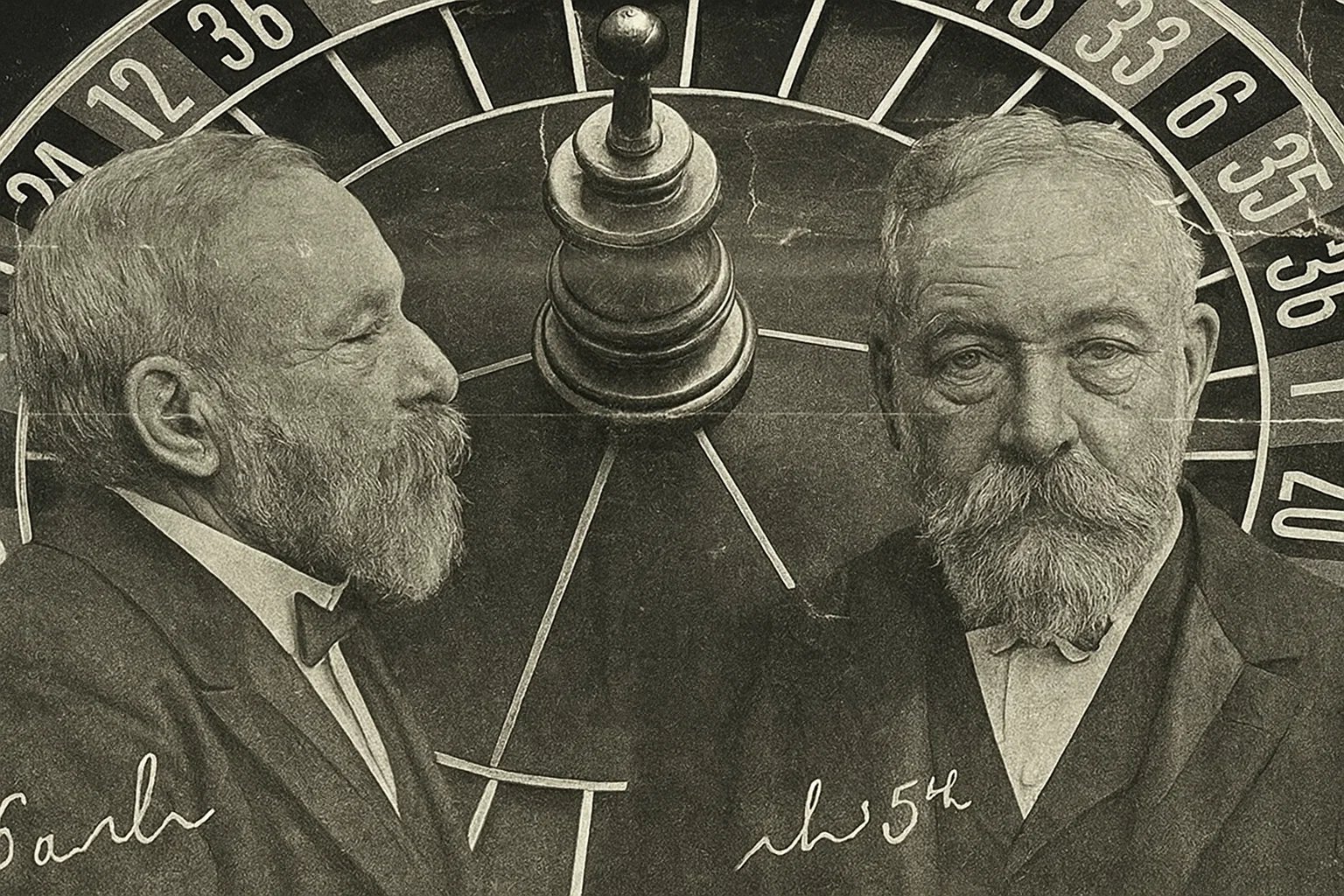
Meet Charles De Ville Wells, the cheeky Brit who broke the bank playing roulette at Monte Carlo in 1891. Starting with $20,000, he won 23 out of 30 spins including five blacks in a row.
Newspapers crowned him a wizard; punters whispered of secret systems and a ‘lucky’ pocket watch. Wells claimed pure instinct. He returned months later, won again, then vanished with the loot, said to be around $130,000, or $13 million in today’s money. The casino closed tables to recover, and his legend inspired the famous ‘the man who broke the bank’ song by Fred Gilbert (1892) and later covered by the likes of Al Jolson and Louis Armstrong.
“As I walk along the Bois de Boulogne
With an independent air
You can hear the girls declare
‘He must be a millionaire!’
You can hear them sigh and wish to die
You can see them wink the other eye
At the man who broke the bank at Monte Carlo.”
Superstition vs Strategy
Although many will say they expertly combine them, superstition and strategy sit on opposite sides of the gambling table for the most part. Superstition is the belief that rituals, charms, or patterns influence random outcomes. Strategy is a deliberate, evidence-based plan to reduce the house edge and maximise expected value (EV). The difference boils down to causal mechanism, testability, impact on rules/odds, and EV improvement.
Knowing how to tell the difference between the two so you can take the repeatability from strategy and the confidence from superstition is probably the sweet spot, so here are some things to keep in mind.
- Causal Mechanism: Superstition assumes mystical or unprovable links, strategy uses clear cause-and-effect.
- Testability: Superstition fails under scrutiny as rituals show no statistical edge in trials. Strategy is testable. For example, card counting in blackjack can be verified with simulations.
- Changes Rules/Odds/Info: Superstition changes nothing. Strategy exploits rules (e.g., doubling in blackjack),
- Improves EV: Superstition does not move the needle in EV, but strategy can increase EV positive in skill games such as poker or reduce losses in games like blackjack.
| Game | Strategy (EV Impact) | Superstition (EV Impact) |
|---|---|---|
| Roulette | Martingale (doubles bets after losses; high risk, no long-term EV gain due to table limits) | Betting 17 (no change in 2.7% house edge) |
| Blackjack | Basic strategy (reduces house edge to around 0.5% in most cases) | Third-base myth (no effect on 0.5% edge) |
| Poker | Position play & pot odds (positive EV with skill) | Lucky hoodie (zero EV change) |
| Slots | Bankroll management (limits losses) | Tapping cabinet (RTP) |
| Baccarat | Betting banker (1.06% edge vs 1.24% player) | Squeezing cards (no edge shift) |
How to Avoid Becoming Reliant on Superstition
Superstition feels harmless, but it can quietly turn dangerous. It breeds over-confidence as a lucky streak tied to a charm convinces you the edge is yours, leading to faster play (more spins per hour) or bigger bets (chasing the “hot” feeling).
Losses can then mount quicker because superstition only shifts mood, not maths. The house edge stays fixed, yet you risk more, believing the rabbit’s foot will save you. Studies show over-confident players lose 20-30% faster. If rituals control your play, pause, and consider responsible gambling tools. That said, there are some things you can do to make sure you don’t become reliant upon rituals and superstitions.
Pre-Commit Plan
Set firm limits before you play. Decide a budget. Write down your limits and stick to them. Pre-commitment beats impulse every time.
Replace Rituals with Routines
Swap charms for controllables. Take scheduled breaks (5 minutes hourly), pace bets sensibly, and use basic strategy aids (blackjack chart for example). Remember: routines build discipline; rituals build illusion.
Test Beliefs
Run tiny experiments. For example, play 50 spins with your charm, log results, then 50 without. You then have data to compare and data kills myths. You can also use tools like roulette spins generators which allow you to enter a strategy and simulate the results from 1,000 spins or more instantly. Nothing breaks belief in a lucky number like cold hard results.
‘If-Then’ Plans
Create implementation intentions. For example: “If I lose three hands in a row and feel the urge to chase, then I stand up and take a 10-minute walk.” Write three ‘If-Then’ rules for tilt moments. They can be strong counter-actions to emotional bets.
Environment
Choose your battlefield and maybe think about avoiding dealer-chasing and gambler fallacy fuelling results boards. Remember, the casinos put them up for a reason and it’s unlikely that it’s because they want to provide you with the tools to win their money. Also consider picking quieter tables with fewer distractions. A calm space keeps decisions rational.
Ask the Right Questions
Before every bet, maybe ask yourself: ‘would a statistician change this bet?’ If the answer is yes, it’s superstition. There is nothing wrong with following a hunch or a gut-feeling now and again, but remember the mantra of ‘maths over mood’ for the majority of your gambling.
“In the glittering dens of Macau and Vegas, superstition’s gone digital. High-rollers pound slot buttons in sharp little bursts, convinced the rhythm “wakes the qi” or sweet-talks the RNG. The habit started during Macau’s post-2002 boom, when flashy hold-and-spin games met ancient instinct. These folks know the math’s cold, but their palms still dance like drummers at a lucky festival.”
Conclusion
Step back from the neon haze, the clatter of chips, and the whispered charms, and the truth glints like a polished roulette ball – namely that superstition is the casino’s oldest accomplice.
It twists randomness into a story, turns a house edge into a dragon to be slain with a rabbit’s foot, and convinces us that mood, not maths, is the master. The tales we’ve explored, like Connery’s triple-17, Wells breaking the bank, Jagger’s tilted wheel, Siegel’s voodoo breath, and Ho’s red underwear, are irresistible because they feel like proof. However, every one of them is a coin flip dressed in legend, correlation dressed as causation.
The wheel doesn’t remember your lucky coin. The cards don’t care about your hoodie. The dice don’t hear your prayers. This is the promise we return to: enjoy the lore but keep decisions math-led. Savour the rabbit’s foot’s soft fur, the cornicello’s cool curve, the maneki-neko’s cheerful wave, but let them be souvenirs, not strategies. Let the stories spark a smile, not a bet. The house edge is the only constant; everything else is theatre, and superstition never takes the curtain call.
FAQs
The Gambler’s Fallacy is the mistaken belief that past random events influence future ones in independent trials. For example, after five red spins in roulette, players think black is ‘due.’ Each spin is separate, with fixed odds. The 1913 Monte Carlo black run proved this when mass red bets lost millions. It’s a cognitive bias, not maths.
No. Lucky numbers (e.g. 7) or charms (e.g. rabbit’s foot) have zero effect on probabilities. They boost mood via placebo, increasing playtime, but not wins in any direct kind of way. A 2018 Psychological Science study showed ‘lucky’ pens raised confidence, not skill. Charms comfort; odds rule.
No. Near-misses (e.g. two jackpot symbols when you need three) are designed to feel like progress but are random. They trigger dopamine, encouraging more play. A 2022 Journal of Gambling Studies report found they increase session length by 15%, but near-misses are illusion, not momentum.
Superstition lacks testable cause while strategy has clear mechanism. Superstition changes nothing; strategy exploits rules/info. Ask ‘does this improve EV?’ If unprovable, it’s superstition. If it’s repeatable and predictable, it’s strategy.
Superstition can breed over-confidence, speeding play (more hands or spins per hour) and inflating bets (chasing ‘hot’ streaks). It shifts mood, not maths, accelerating losses.
Pre-commit limits (budget, time). Replace rituals with routines (breaks, pacing). Test beliefs with logs. Use If-Then plans (‘If I lose three, then I walk’). Choose calm environments. Remember that while superstition can be fun and create great stories, data beats delusion when you’re seeking to keep control.
Meet The Author
Experience

Lynsey is a regular Las Vegas visitor and a keen slots and roulette player. As well as significant experience as a writer in the iGaming and gambling industries as an expert reviewer and journalist, Lynsey is one half of the popular Las Vegas YouTube Channel and Podcast 'Begas Vaby’. When she is not in Las Vegas or wishing she was in Las Vegas, Lynsey can usually be found pursuing her other two main interests of sports and theatre.
Read Full BioTest Your Luck
Not Your Spam Filter
Sign up to receive emails and promotions from Casinos.com