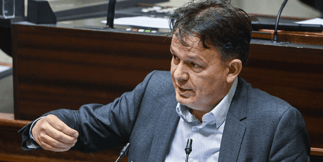
University of Illinois Athletics Director Josh Whitman (left), seen here with Michigan State head men’s basketball coach Tom Izzo (right), says it’s time for the NCAA to rethink rules about college gambling. (Photo: Craig Pessman / AP)
The NCAA is considering a proposal that would allow student-athletes and staff members to place bets on professional sports, with an eye to focus more on preventing betting on college sports and other activities that could impact the integrity of events.
The proposal, introduced by the Division I Council, could be adopted in October. However, it would only be implemented if Division II and Division III also vote to allow professional sports betting.
Targeted Enforcement Could Replace ‘Abstinence-Only’ Betting Policies
Currently, NCAA rules prohibit athletes and institutional staff from betting on any level of any sport in which there are NCAA championships. And while the Division I Board of Directors issued the directive which led to this proposal, the Division I Council said it does not constitute an endorsement of sports betting.
“NCAA rules prohibiting sports betting at all levels were written and adopted at a time when sports gambling was largely illegal nationwide,” Josh Whitman, athletics director at the University of Illinois and chair of the Division I Council, said in a statement. “As betting on sports has become more widely accepted across the country, Division I members have determined that further discussion of these sports betting rules is warranted, particularly as it relates to the potential distinctions between betting on professional versus collegiate sports.”
If the rule on professional sports betting chances, it would not be applied retroactively. However, officials say that it might be easier to work with staff and players to prevent problematic betting behaviors rather than attempt to stop them from gambling entirely.
“Deregulating professional sports betting may provide schools an additional opportunity to implement harm-reduction strategies, which can be more effective and have long-term benefits not seen with abstinence-only approaches,” Dr. Deena Casiero, NCAA chief medical officer, said in a statement.
Players Face Harsh Punishments for Betting on Own Teams, Sports
Division I schools have already softened the reinstatement guidelines for student-athletes that have bet on professional sports as part of the focus on harm reduction. However, the NCAA is maintaining rules that result in a permanent loss of any remaining collegiate eligibility for any student-athletes that wagers on their own team or on their own sport.
The move comes after the NCAA has had to deal with a variety of betting scandals in recent seasons.
In February 2025, three players were suspended or removed from the Fresno State University Bulldogs men’s basketball team after reports that they made bets on basketball, with two players allegedly placing Under prop bets on their own team. The next month, Notre Dame suspended its entire men’s swimming team for gambling violations.
In 2023, investigators used geofencing software to charge 16 athletes at three universities in Iowa with criminal charges, with 12 of those individuals pleading guilty to underage gambling. Lawyers for 26 athletes filed a federal lawsuit against law enforcement officers related to that case in April 2024, saying that the technology was used to access information on students’ cell phones without a warrant.
Concerns about points shaving and other integrity issues in college athletics have been a particular concern with the rapid expansion of sports betting in the United States. That has led several states to prohibit individual player prop bets on college sports.
Meet The Author
Experience

Ed Scimia is an experienced writer who has been covering the gaming industry since 2008. He graduated from Syracuse University in 2003 with degrees in Magazine Journalism and Political Science. As a writer, Ed has worked for About.com, Gambling.com, and Covers.com, among other sites. He has also authored multiple books and enjoys curling competitively, which has led to him creating curling-related content for his YouTube channel, "Chess on Ice."
Read Full BioRelated News









Test Your Luck
Not Your Spam Filter
Sign up to receive emails and promotions from Casinos.com