Why Regulators Worldwide Are Watching the UK’s Online Slots Reforms


Eyes on the UK's slot world. (Image: Terry Waller/Alamy
For regulators in Europe, Australia and beyond, Britain’s recent overhaul of online slot machine rules is emerging as a live case study in balancing safer gambling with market stability.
In 2024 and 2025, the UK rolled out statutory limits on how much licensed players can stake per spin on online slots, a sector long criticised as a high risk form of gambling without equivalent protections to land based machines. The policy, which varies by age group, aims to reduce harm among vulnerable players without driving them to unregulated operators or crushing commercial activity.
A Targeted, Age Based Stake Limit
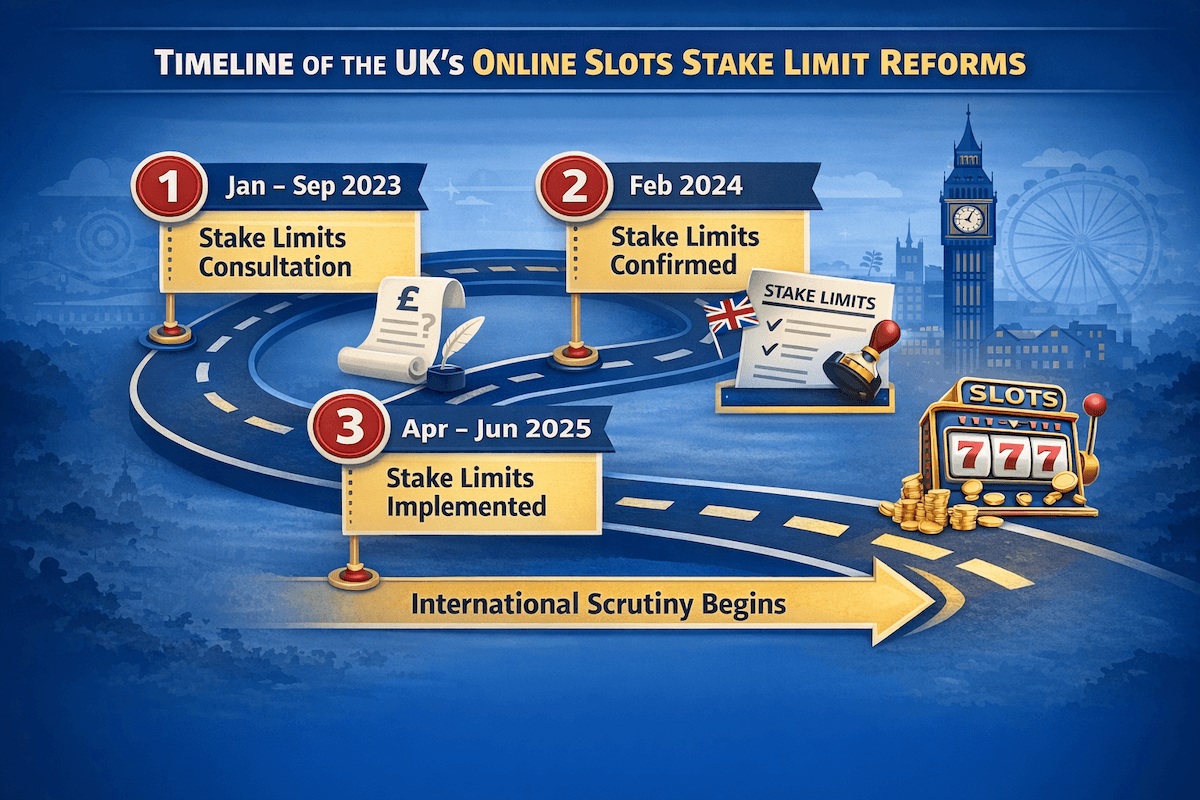
The United Kingdom’s Department for Culture, Media and Sport and the UK Gambling Commission confirmed in 2024 that new maximum stake limits would be introduced for online slot games. For the first time, all UK licensed operators must cap bets per game cycle to protect consumers. Under the Gambling Act 2005 (Operating Licence Conditions) (Amendment) Regulations 2025, players 25 and older are limited to a £5 maximum stake per spin, and those aged 18 to 24 to £2 per spin. The new licence condition took effect in stages during April and May 2025.
The limits apply only to reel based online slot games, not to other casino formats such as roulette or blackjack. A “game cycle” means the period from initiating a spin to the full resolution of wins or losses.
Officials justified the differentiated approach by citing evidence that younger adults have higher problem gambling rates and may face greater financial vulnerability. The measures were part of a broader consultation that began in 2023 under the UK government’s gambling white paper and white paper response.

Early Indicators: Behaviour, Not Exodus
Data from the first months after implementation suggests that while average bet sizes have fallen, player engagement and active accounts have remained relatively stable. A wide decline in gross gambling yield (GGY) or mass account closures, outcomes feared by some operators, has not materialised according to industry analysts tracking early post reform figures. (Independent yield figures are still emerging, and authoritative quarterly returns from the Gambling Commission are expected later in 2026.)
Regulators elsewhere are paying attention to this pattern. It suggests players adapt stake behaviour rather than abandon platforms, indicating a potential path for harm reduction that does not induce major market disruption.
International Context: From Blunt Caps to Calibrated Limits
The UK’s model stands in contrast to other jurisdictions pursuing uniform limits. For example, Germany has implemented a flat €1 stake cap on online slot games, a far stricter ceiling that critics say may push players offshore or shrink licensed activity. (National and state rules vary in other European markets.) In Australia and parts of Canada, regulators and public health bodies have discussed similar caps or speed limits on electronic gambling play, though broad statutory caps are less common. (Specific comparative limits vary by state and jurisdiction.)
What distinguishes the UK’s approach is its age weighted calibration, aimed at aligning risk exposure with vulnerability and not imposing blanket constraints on all consumers.
What This Means for the Gambling Industry
Operators and game providers have largely complied with the technical implementation challenges imposed by the new caps. Updating thousands of game instances, verifying player ages accurately, and enforcing stakes per cycle have tested platforms but avoided major market shocks.
For public health advocates, the UK reforms represent a middle path between prohibition and neglect, reducing high risk exposure while allowing recreational play to continue under clear guardrails.
Industry stakeholders in Europe, Asia and Australia are now observing whether these early outcomes persist in the longer term. If the UK manages to sustain market health while measurably reducing harmful patterns, its stake limit framework could become a blueprint for internationally coordinated regulatory design.
What Comes Next
The UK government and the Gambling Commission plan ongoing post implementation reviews, with future reports expected to provide comprehensive analysis of player behaviour, market yield trends, and harm indicators. As evidence accumulates, other regulators may adopt similar stratified stake limits or integrate the model into broader responsible gambling toolkits.
For now, the UK remains one of the few major gambling markets with statutory age tiered online slot limits, and the world is watching how that experiment unfolds.
Meet The Author
Experience

 News Writer
Most of my career was spent in teaching including at one of the UK’s top private schools. I left London in 2000 and set up home in Wales raising four beautiful children. I enrolled at University where I studied Photography and film and gained a Degree and subsequently a Masters Degree. In 2014 I helped launch a new local newspaper and managed to get front and back page as well as 6 filler pages on a weekly basis. I saw that journalism was changing and was a pioneer of hyperlocal news in Wales. In 2017 I started one of the first 24/7 free independent news sites for Wales. Having taken that to a successful business model I was keen for a new challenge. Joining the company is exciting for me especially as it is a new role in Europe. I am keen to establish myself and help others to do the same.
Read Full BioRelated News










Test Your Luck
Not Your Spam Filter
Sign up to receive emails and promotions from Casinos.com