Industry claims the illegal gambling market has an unfair advantage. (Image: Homer Sykes/Alamy)
Licensed operators in the UK operate under one of the most comprehensive gambling regulatory regimes globally, overseen by the UK Gambling Commission under the Gambling Act 2005. Requirements include customer identity verification, anti-money laundering checks aligned with the Proceeds of Crime Act 2002, and participation in national self-exclusion schemes such as GamStop.
They also pay significant tax. Since August 2017, most remote gambling operators serving UK customers have paid a 21% Remote Gaming Duty on profits. In addition, land-based casinos are subject to Gaming Duty on a tiered basis of up to 50%, depending on gross gaming yield.
Industry analysts have warned that when tax rates rise and product restrictions tighten, some consumers may seek alternatives that offer fewer controls, faster withdrawals, or greater anonymity. This is often referred to as a channelisation risk, the percentage of players using licensed versus unlicensed platforms.
The UK Gambling Commission has previously stated that maintaining high channelisation rates is critical to consumer protection. If players migrate to unlicensed sites, regulators lose oversight, and customers lose safeguards.
Consumer Confusion And Digital Brand Misuse
For players, spotting the difference between licensed and illegal operators is not always straightforward.
Professional website design, familiar payment methods, and search engine visibility can create a veneer of legitimacy. In some documented cases, unlicensed operators have mimicked branding elements of regulated sites or bid on brand names in paid search advertising.
Licensed casinos must display their licence details, including a licence number issued by the UK Gambling Commission, which can be verified on the Commission’s public register. They must also provide access to dispute resolution services and integrate responsible gambling tools such as deposit limits, time-outs, and self-exclusion options.
Illegal platforms often lack verifiable licensing information, provide limited corporate transparency, and do not offer independent complaint mechanisms. Identity verification may be minimal or non-existent. That absence of oversight can expose players to non-payment of winnings, data misuse, or unfair terms.
For consumers concerned about rigged games, withheld withdrawals, or misuse of personal data, the distinction matters.
Hippodrome Flags ‘Competitive Advantage’ For Illegal Operators
The debate is not limited to online casino platforms. The Hippodrome Casino in London has raised concerns about illegal land-based gambling operations.
A spokesperson for the Hippodrome Casino told Casinos.com: “For us, the issue is less about unlicensed online casinos and more about illegal land based casinos operating in plain sight in the heart of London’s West End and across GB.”
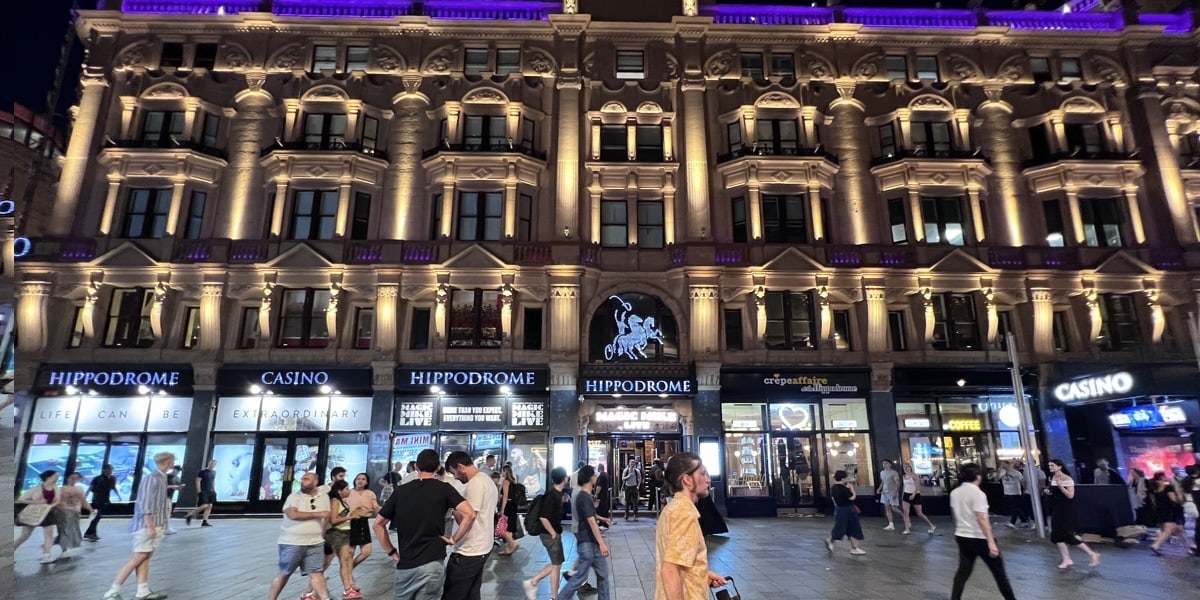
A star attraction in London's West End, The Hippodrome Casino. (Image: Alan Evans/Casinos.com)
The Hippodrome, one of the UK’s largest land-based casinos, pays substantial tax under the UK’s gaming duty structure. According to the company’s public filings, it is among the highest-profile casino operators in London’s West End.
“High rates of taxation and high regulatory requirements confer a huge competitive advantage on unlicensed operators,” the spokesperson said.
“The Hippodrome pays £45m in tax every year, an effective rate of 42% on the gaming part of it. Unlicensed casinos pay nothing and have no compliance or player safety tools. No self exclusion, No KYC, EDD, SOF. This means that they have a much lower cost base, which gives them a major pricing advantage.
KYC refers to ‘Know Your Customer’ checks, EDD to enhanced due diligence, and SOF to source of funds verification, all mandatory elements of UK anti-money laundering compliance for licensed operators.
The spokesperson added that some compliance obligations can affect customer experience.
“Some of the regulations by which we are bound are not very customer-centric. Illegal casinos do not have any compliance requirements, so they do not have to push their customers for information and track their play, and this can be another form of competitive advantage.”
The Hippodrome also pointed to proposed advertising restrictions.
“One of the advantages of licensing is that legitimate operators are permitted to advertise and this helps consumers distinguish between licensed and unlicensed operations. Now even this is under threat, see proposals for TfL ban etc.”
How Big Is The Illegal Market?
Estimating the size of the illegal gambling market remains contentious.
In November 2023, the UK Gambling Commission published a report examining illegal gambling activity in Great Britain. The regulator concluded that measuring the black market with precision is difficult due to methodological challenges, including defining what constitutes ‘illegal’ and tracking offshore traffic.
A spokesperson for the Commission told Casinos.com: “As we set out in our November report on the illegal gambling market we do not think it is currently possible to make a robust and reliable estimate of the size of the unlicensed market.”
“In addition we urge caution over any estimates presented by third parties or commentators which don’t have a transparent methodology, or which do not show how the challenges in this report have been considered, or that provide precise ‘point estimates’ without clarity of the associated margins for error and caveats.”
What Is Being Done To Tackle Illegal Gambling?
The Commission emphasised that enforcement action is ongoing.
“It is illegal to provide gambling facilities to consumers in Great Britain without an operating licence from the Gambling Commission,” the spokesperson said.
“We have been delivering one of the most comprehensive programmes of work globally to tackle the illegal gambling market. With new powers and funding being provided to us by Government we will be expanding and accelerating that action even further.”
Between April 2025 and the end of January 2026, the Commission reported:
• Issuing 1,039 cease and desist notices to advertisers and operators
• Reporting 334,226 URLs to search engines, with 207,865 removed
• Referring 911 websites for delisting
• Disrupting 340 websites through takedown or geo-blocking
The spokesperson added: “We are also working with domain registrars, hosting providers, social media platforms and international partners to suspend domains, disrupt payment flows, tackle aggressive marketing and prevent illegal sites from being accessed from Great Britain. Alongside that we have active prosecutions currently going through the criminal justice system.”
“In addition, the Government’s Crime and Policing Bill will grant the Commission greater powers to act to block IP addresses and domain names linked to illegal websites.”
“Tackling unlicensed gambling requires a joined-up approach, between the Commission, other domestic and international regulators, GamStop, licensed operators, technology platforms, financial sectors and enforcement bodies, and we will continue to strengthen that collaboration to better protect consumers.”
A Structural Fault Line In Regulated Gambling
Not all policymakers agree that enforcement is misdirected. Some argue that strict oversight of licensed operators is essential to maintain consumer trust and that black-market suppression must occur alongside domestic regulation.
But the debate is shifting. The issue is no longer framed solely as compliance versus non-compliance. It is about whether regulatory frameworks unintentionally erode the competitiveness of the very operators tasked with upholding consumer protections.
If licensed operators face rising tax burdens and tighter restrictions, while illegal alternatives remain accessible online or in physical premises, channelisation rates could fall. That would affect tax revenues, investment, and player safeguards.
For consumers, the implications are immediate. The difference between licensed and illegal is not just a matter of paperwork. It determines whether disputes can be independently resolved, whether identity checks protect against fraud, and whether responsible gambling tools are available.
For regulators and governments, the stakes are equally high. The balance between robust oversight and market viability may define the next phase of regulated gambling policy in the UK and beyond.
The Gambling Commission concluded: “As we set out in our November report on the illegal gambling market we do not think it is currently possible to make a robust and reliable estimate of the size of the unlicensed market.
Meet The Author
Experience

 News Writer
Most of my career was spent in teaching including at one of the UK’s top private schools. I left London in 2000 and set up home in Wales raising four beautiful children. I enrolled at University where I studied Photography and film and gained a Degree and subsequently a Masters Degree. In 2014 I helped launch a new local newspaper and managed to get front and back page as well as 6 filler pages on a weekly basis. I saw that journalism was changing and was a pioneer of hyperlocal news in Wales. In 2017 I started one of the first 24/7 free independent news sites for Wales. Having taken that to a successful business model I was keen for a new challenge. Joining the company is exciting for me especially as it is a new role in Europe. I am keen to establish myself and help others to do the same.
Read Full BioRelated News


Test Your Luck
Not Your Spam Filter
Sign up to receive emails and promotions from Casinos.com